

Algebra: Euler’s dice
View Sequence overviewThe number of faces, edges, and vertices in prisms and pyramids follow predictable patterns that can be expressed algebraically.
Euler’s rule $F + V − E = 2$ holds for every prism and pyramid.
Whole class
Euler’s dice Slides
Models of prisms and pyramids, either paper nets printed from Paper models of polyhedra (with at least three copies of each) or access to 3D modelling software such as Tinkercad to create their own models. Models should include triangular, square, pentagonal, hexagonal, and octagonal prisms and pyramids.
Each student
Patterns and pronumerals Student sheet
Task
Display Slide 3 of Euler’s dice Slides to remind students of the driving question.
Ask students to find the definitions they wrote in Task 1 for prisms and pyramids. Give them a moment to read them back.
Ask: If every die we build has to be either a prism or a pyramid, are there any face counts that would be impossible? Write down a prediction and your reasoning.
Take a few responses and record them publicly. Ask:
- Who thinks some face counts are impossible? Which ones, and why?
- Who thinks any face count works? What makes you confident?
- Can anyone use their prism or pyramid definition to argue either way?
Tell students that the goal for today is to find rules that describe the structure of prisms and pyramids, rules precise enough to answer the designer’s question without having to build every shape by hand.
Hand out the Patterns and pronumerals Student sheet and the printed nets from Paper Models of Polyhedra. Each group needs three nets to fold and count, with at least two groups working from the same net. The student sheet contains a table with columns for object, base shape, and number of faces, vertices, edges, and base sides, with rows for triangular, square, pentagonal, hexagonal, and octagonal prisms and pyramids.
Print nets for the ten shapes in the class data table: triangular, square, pentagonal, hexagonal, and octagonal prisms and pyramids. On the Polyhedra.net site, these are listed under “Prisms” and “Pyramids” in the main menu.
For fast finishers, the site also includes more unusual polyhedra such as antiprisms and Johnson solids. These make good extension objects for the “What else can you find?” section. Ask students to check these shapes against their definitions from Task 1: are they prisms, pyramids, or neither?
Explain the task: Everyone needs to fill in the whole table by the end of the lesson. Each group is responsible for counting the faces, edges, and vertices of three objects. Every object will be counted by at least two groups, so if there is a disagreement we will need to sort it out together.
Assign three objects to each group. When a group finishes counting, they add their results to the class table on the board. Once the table is complete, check for disagreements before students copy it down. Where two groups have different counts, ask both to explain how they counted, then have a third group recount using a different strategy.
Physical 3D models make counting faces, edges, and vertices significantly easier than working from images or drawings. A few options:
- Paper nets: Pre-printed paper nets give students a physical object to fold and count. Polyhedra.net has printable nets for a wide range of shapes and is free to use. The Wolfram Demonstrations Project is another source of nets, though it requires the free Wolfram Player to be installed.
- Digital models: Students can create prisms and pyramids with any base polygon using Tinkercad, a free browser-based design tool. Once built, shapes can be rotated freely to count faces, edges, and vertices from any angle. This works well as a self-contained digital option where students build their assigned shape and then count directly from the model.
- 3D printing: With access to a 3D printer, shapes can be built in Tinkercad and printed as physical manipulatives ahead of class. Physical models are particularly useful for students who find counting on a screen difficult.
Ask students to look at their completed table and find as many patterns as they can. These can be recorded on pages 2-3 of the Patterns and pronumerals Student sheet. Encourage them to share noticings with their group as they go. Once groups have had time to discuss, ask: For each pattern your group found, can you explain why it holds? Can you point to the part of the object that explains it?
Give students few minutes to write their explanations before sharing with the class together. For each pattern, ask: Does anyone have a different explanation for why that works?
In the equations below, $F$ refers to the number of faces, $B$ refers to the number of base edges, $E$ refers to the number of edges and $V$ refers to the number of vertices.
| Formula | Object type | Geometric explanation |
| $$F = B + 2$$ | Prism | One parallelogram face for each base side, plus the two base faces |
| $$E = 3B$$ | Prism | $B$ edges around the top, $B$ around the bottom, and $B$ vertical edges connecting them |
| $$V = 2B$$ | Prism | $B$ vertices on the top face and $B$ matching vertices on the bottom |
| $$F = B + 1$$ | Pyramid | One triangular face for each base side, plus the base itself |
| $$E = 2B$$ | Pyramid | $B$ edges around the base and $B$ edges connecting each base vertex to the apex |
| $$V = B + 1$$ | Pyramid | $B$ vertices around the base plus the apex |
| $$V = F$$ | Pyramid | $V$ and $F$ both equal $B + 1$, so the number of vertices always equals the number of faces |
Work toward word-based rules first. Once a word rule is on the board, introduce algebraic shorthand. Take one rule and revoice it: You said “The number of faces equals the number of base edges plus two.” If we let $B$ stand for the number of base edges and $F$ stand for the number of faces, we can write that as $F = B + 2$. Is that what you meant?
When introducing pronumerals here, two things are worth making explicit:
- These letters represent numbers, not labels. $F$ does not mean “faces”, it means “the number of faces”.
- Once students have written a rule, they can use it to find missing values by substituting. For example, if $F = B + 2$ and a prism has a hexagonal base, then $F = 6 + 2 = 8$. This is substitution, and it is worth naming explicitly when it first appears.
Write the pronumerals and their definitions on the board:
- Let $B$ = the number of edges of the base.
- Let $F$ = the number of faces.
- Let $E$ = the number of edges of the object.
- Let $V$ = the number of vertices.
Ask students to rewrite their word rules using these pronumerals. Then pose the open challenge: Can you find any other relationships between $F$, $E$, $V$, and $B$? You do not have to stick to the rules we have already written together.
Give students time to explore independently or in pairs, then collect everything on the board.
Listen for the quality of reasoning rather than just whether students arrive at a correct rule. A strong response names the specific parts of the object that account for each count: There are two extra faces because every prism has a top and a bottom, no matter what the base is. A surface response restates the pattern without explaining it: It’s $B + 2$ because you add 2.
If students are restating rather than explaining, ask: Where do those two extra faces actually come from? Can you point to them?
Open-ended tasks: more than one right answer

This task asks students to find as many valid formulas as they can from the completed table, rather than working toward a single predetermined answer.
When students know exactly what answer they are looking for, some of their cognitive effort goes toward monitoring whether they are on the right track rather than thinking about the mathematics itself. A task with multiple valid endpoints removes that monitoring burden, freeing students to focus on noticing and describing relationships.
In practice, this also means every student can succeed. A student who finds $F = B + 2$ and a student who finds $V = F$ for pyramids have both produced valid algebraic results. Peter Sullivan’s work on mathematics task design makes a similar point: tasks with multiple valid endpoints tend to engage a wider range of students because there is always something true to find. His book Open-ended maths activities: Using ‘good’ questions to enhance learning in mathematics is a practical reference for teachers who want to explore this further.
References
Sullivan, P. & Lilburn, P. (2004). Open-ended maths activities: Using ‘good’ questions to enhance learning in mathematics (2nd ed.). Oxford University Press.
This task asks students to find as many valid formulas as they can from the completed table, rather than working toward a single predetermined answer.
When students know exactly what answer they are looking for, some of their cognitive effort goes toward monitoring whether they are on the right track rather than thinking about the mathematics itself. A task with multiple valid endpoints removes that monitoring burden, freeing students to focus on noticing and describing relationships.
In practice, this also means every student can succeed. A student who finds $F = B + 2$ and a student who finds $V = F$ for pyramids have both produced valid algebraic results. Peter Sullivan’s work on mathematics task design makes a similar point: tasks with multiple valid endpoints tend to engage a wider range of students because there is always something true to find. His book Open-ended maths activities: Using ‘good’ questions to enhance learning in mathematics is a practical reference for teachers who want to explore this further.
References
Sullivan, P. & Lilburn, P. (2004). Open-ended maths activities: Using ‘good’ questions to enhance learning in mathematics (2nd ed.). Oxford University Press.
Tell students: You have found rules for prisms and rules for pyramids. But do any of those rules work for both families at once?
Give students a moment to check. They will quickly find that the rules involving $B$ do not always transfer. For example, $F = B + 2$ holds for prisms but not pyramids.
Then ask: Set $B$ aside for now. Look only at the columns for $F$, $V$, and $E$. Is there any relationship between these three variables that holds for every row in the table, prisms and pyramids alike?
Encourage students to try combining $F$, $V$, and $E$ in different ways and to check any relationship they find against every row, not just one or two.
Checkpoint: Pause the class. Ask one or two pairs to share what they have tried, including dead ends. Listen for whether students are testing relationships across all rows or only checking one or two cases. If the latter, prompt: Does it work for every shape in your table? If no group is close to $F + V - E = 2$, ask: Has anyone tried adding two of the columns together? Or subtracting one from another? Then send students back to continue.
Once groups start finding $F + V - E = 2$, ask them to verify it holds for every row before sharing with the class.
- The task asks you to set $B$ aside completely. Can you cover that column and just look at $F$, $E$, and $V$?
- Pick any two shapes and compare their values for $F$, $E$, and $V$. Is there anything that stays the same?
- Try calculating $F + V$ for every shape in the table. What do you notice?
- You have tried multiplying. What happens if you try adding or subtracting instead?
If students are struggling, prompt with: You have three numbers in each row: $F$, $V$, and $E$. Try combining any two of them using addition or subtraction. Can you get the third?
Bring the class together and collect results. If different groups have written the relationship $F + V - E = 2$ in different but equivalent forms, put all versions on the board.
It is likely that different groups will have written the relationship in different but equivalent forms. For example, one group might write $F + V - E = 2$, another might write $F + V = E + 2$, and another might write $E = F + V – 2$. Write all versions on the board without indicating whether any of them are correct, and ask: Are all of these saying the same thing? How can you tell? Give students a moment to check each version against their table before discussing. The goal is for students to recognise that rearranging an equation preserves the relationship—a key algebraic idea that is worth naming explicitly once students have convinced themselves it is true.
Checkpoints
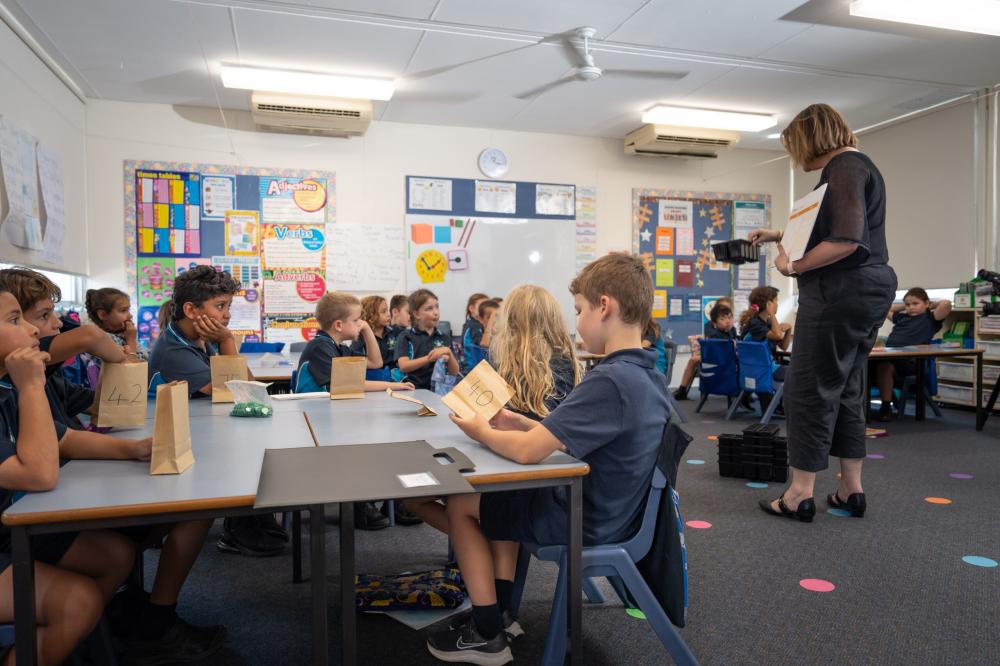
A checkpoint is a structured pause during an investigation where students briefly account for their progress, share what they have tried, and hear how other groups are approaching the same problem. It is not a full class discussion and does not require every group to share. It is a short, focused moment designed to maintain momentum rather than interrupt it.
Select two or three groups to share what they have tried so far, including dead ends. Other students often pick up useful ideas from each other without being told what to do next.
In this activity, a well-timed checkpoint might surface the useful strategy of trying addition and subtraction first, or flag that some groups are still working with $B$ when the task asks them to set it aside entirely. Revisiting the original question (find a relationship between $F$, $E$, and $V$ that holds for every shape) helps students who have lost the thread refocus without the teacher having to intervene with every group individually.
A checkpoint is a structured pause during an investigation where students briefly account for their progress, share what they have tried, and hear how other groups are approaching the same problem. It is not a full class discussion and does not require every group to share. It is a short, focused moment designed to maintain momentum rather than interrupt it.
Select two or three groups to share what they have tried so far, including dead ends. Other students often pick up useful ideas from each other without being told what to do next.
In this activity, a well-timed checkpoint might surface the useful strategy of trying addition and subtraction first, or flag that some groups are still working with $B$ when the task asks them to set it aside entirely. Revisiting the original question (find a relationship between $F$, $E$, and $V$ that holds for every shape) helps students who have lost the thread refocus without the teacher having to intervene with every group individually.
Tell students that the relationship they found has a name. Display the rule:
$$F + V - E = 2$$
Explain that this is called Euler’s rule, named after the Swiss mathematician Leonhard Euler (pronounced “oil-er”). It holds for all polyhedra without holes, not just prisms and pyramids.
Page 4 of the Patterns and pronumerals Student sheet, which gives practice substituting values into the algebraic rules found in this task, can be completed in class if time allows or set as homework.
Euler’s rule: when it works and when it doesn’t
Euler’s rule $F + V - E = 2$ holds for any polyhedron that is topologically equivalent to a sphere, meaning its surface could in theory be continuously stretched and deformed into a sphere without tearing or poking new holes in it. All prisms and pyramids satisfy this, which is why the rule is reliable throughout this sequence.
The rule gives different results when the topology changes. A polyhedron with one hole or tunnel gives $F + V - E = 0$. Each additional hole reduces the result by two. A compound polyhedron (two separate polyhedra interpenetrating each other) is topologically two spheres rather than one, giving $F + V - E = 4$.
These edge cases are explored in depth in Imre Lakatos’s Proofs and Refutations, which examines how mathematicians grappled with exactly these kinds of failures and what they revealed about the nature of mathematical definitions. Lakatos shows how early versions of Euler’s rule kept failing on unusual polyhedra and how each failure forced mathematicians to refine their definitions. In each case, the question was not just whether the rule held, but what counted as a face, an edge, and a vertex in the first place.
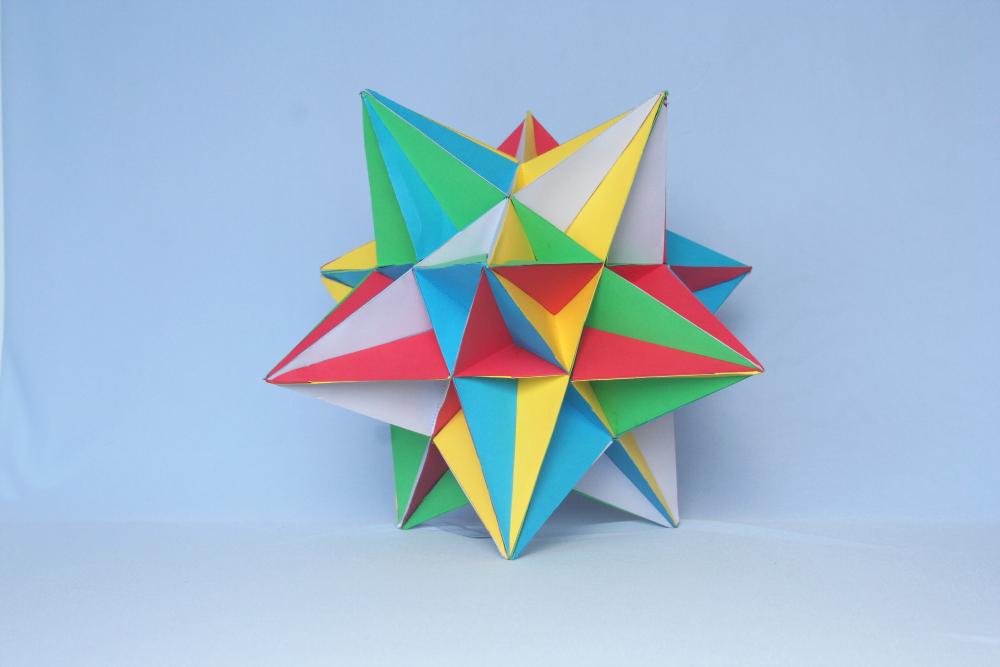
Lakatos used the term “monsters” to describe shapes that appeared to be valid polyhedra but caused Euler's rule to break down. One such monster is the small stellated dodecahedron: it is a spiky ball with no holes, yet $F + V - E = -6$. This unexpected result comes down to an ambiguity in what counts as a face: each star point can be treated as a single self-intersecting pentagram face, or as five triangular faces. Each interpretation gives a different count. The shape doesn’t break the rule so much as expose that the rule was never as unambiguous as assumed.
Beyond Euler’s rule, the question of which combinations of $F$, $V$, and $E$ correspond to real polyhedra is addressed by Steinitz’s theorem: a combination corresponds to a valid convex polyhedron if and only if its graph is both planar and 3-connected.
While many of these ideas are well beyond Year 7, Proofs and Refutations is highly recommended for teachers who want to understand why the definition of polyhedron matters as much as the rule itself.
References
Lakatos, I. (1976). Proofs and refutations: The logic of mathematical discovery. Cambridge University Press.
Euler’s rule $F + V - E = 2$ holds for any polyhedron that is topologically equivalent to a sphere, meaning its surface could in theory be continuously stretched and deformed into a sphere without tearing or poking new holes in it. All prisms and pyramids satisfy this, which is why the rule is reliable throughout this sequence.
The rule gives different results when the topology changes. A polyhedron with one hole or tunnel gives $F + V - E = 0$. Each additional hole reduces the result by two. A compound polyhedron (two separate polyhedra interpenetrating each other) is topologically two spheres rather than one, giving $F + V - E = 4$.
These edge cases are explored in depth in Imre Lakatos’s Proofs and Refutations, which examines how mathematicians grappled with exactly these kinds of failures and what they revealed about the nature of mathematical definitions. Lakatos shows how early versions of Euler’s rule kept failing on unusual polyhedra and how each failure forced mathematicians to refine their definitions. In each case, the question was not just whether the rule held, but what counted as a face, an edge, and a vertex in the first place.
Lakatos used the term “monsters” to describe shapes that appeared to be valid polyhedra but caused Euler's rule to break down. One such monster is the small stellated dodecahedron: it is a spiky ball with no holes, yet $F + V - E = -6$. This unexpected result comes down to an ambiguity in what counts as a face: each star point can be treated as a single self-intersecting pentagram face, or as five triangular faces. Each interpretation gives a different count. The shape doesn’t break the rule so much as expose that the rule was never as unambiguous as assumed.
Beyond Euler’s rule, the question of which combinations of $F$, $V$, and $E$ correspond to real polyhedra is addressed by Steinitz’s theorem: a combination corresponds to a valid convex polyhedron if and only if its graph is both planar and 3-connected.
While many of these ideas are well beyond Year 7, Proofs and Refutations is highly recommended for teachers who want to understand why the definition of polyhedron matters as much as the rule itself.
References
Lakatos, I. (1976). Proofs and refutations: The logic of mathematical discovery. Cambridge University Press.