


'Mathematical modelling: Cracking codes' is one of our new teaching sequences for V9
- On the 'In this sequence' tab you'll find all the lessons in this sequence, a suggested implementation plan and curriculum alignment.
- The 'Behind this sequence' tab shows how key mathematical ideas develop over the sequence.
- Have you taught this sequence? Use the Feedback button to let us know how it went!
Lessons in this sequence

Lesson 1 • Deciphering ciphers
Students attempt to decipher codes encrypted with a substitution cipher and reflect on the strategies they found particularly helpful.


Lesson 2 • Exploring frequency
Students predict the frequency of letters in the English alphabet, then analyse a piece of text to compare and refine their predictions.

Lesson 3 • Frequency analysis
Students use a spreadsheet to analyse letter frequency in a text and compare it to the typical distribution in the English language.

Lesson 4 • Code crackers
Students apply letter frequency and language patterns to decipher codes encrypted with a substitution cipher.

Curriculum and syllabus alignment
Year 7
Students plan and conduct statistical investigations involving discrete and continuous numerical data, using appropriate displays. Students assign probabilities to outcomes and predict relative frequencies for related events. They run simulations using digital tools, giving reasons for differences between predicted and observed results.
Statistics
Plan and conduct statistical investigations involving data for discrete and continuous numerical variables; analyse and interpret distributions of data and report findings in terms of shape and summary statistics
Probability
Identify the sample space for single-stage events; assign probabilities to the outcomes of these events and predict relative frequencies for related events
Conduct repeated chance experiments and run simulations with a large number of trials using digital tools; compare predictions about outcomes with observed results, explaining the differences
In this sequence, students use mathematical modelling to develop strategies for deciphering messages encrypted with a simple substitution cipher. In such ciphers, each letter in the original message is replaced with a different letter, number, or symbol according to a fixed system. The ciphers students work with involve a one-to-one substitution where each letter of the alphabet has been swapped with a unique alternative. As part of the sequence, students explore patterns in the English language, focusing on the typical frequency of letter usage. They learn that understanding these frequency patterns can serve as a powerful tool in code breaking.
This teaching sequence highlights the rich connections between mathematics, English, and digital technologies.
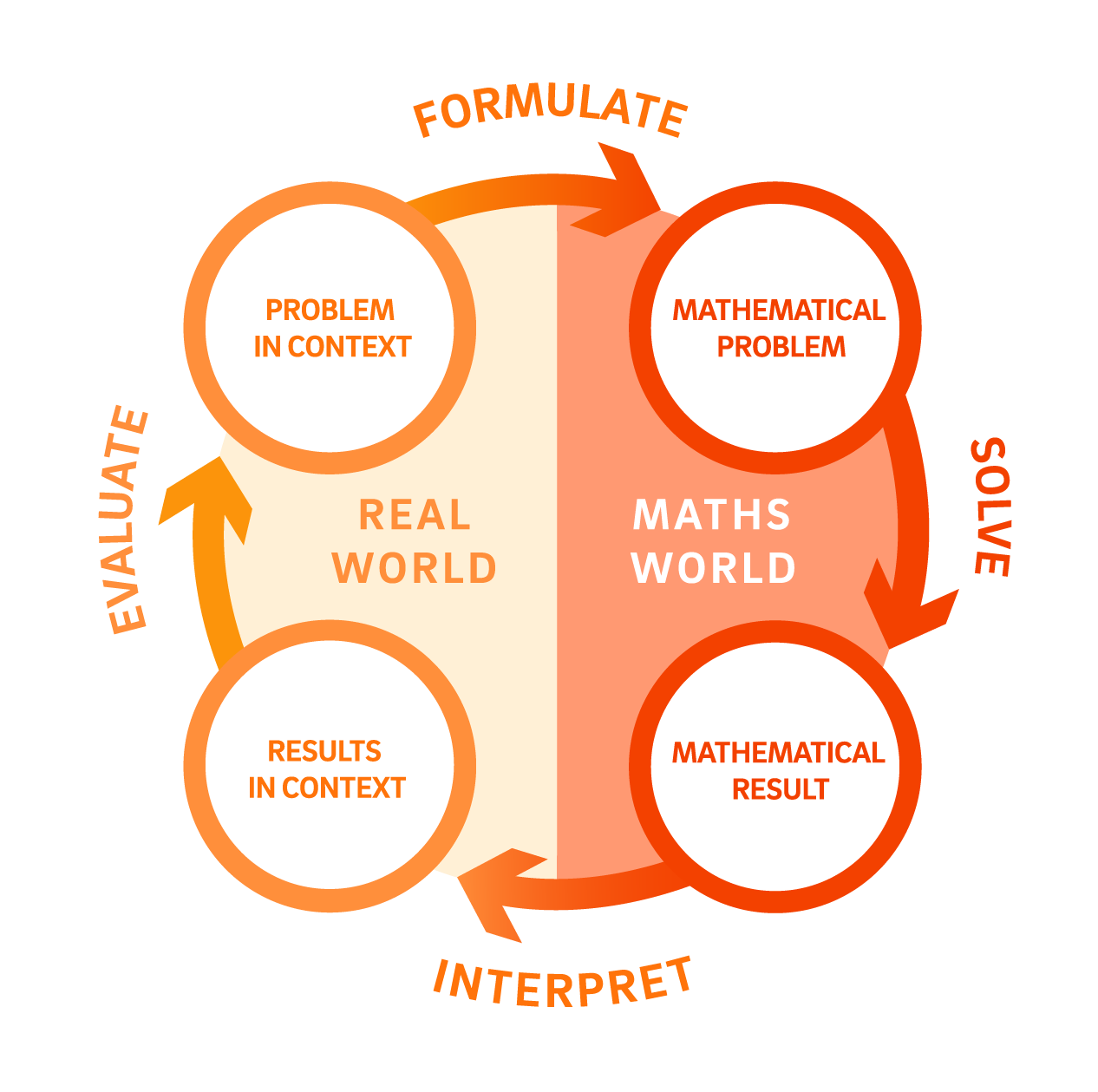
The process of mathematical modelling in this sequence
Formulate
Students are introduced to the problem of deciphering codes encrypted with a substitution cipher. By exploring codes directly, they identify strategies that help, such as letter frequency and language patterns, and consider how mathematics might be used as a tool in code breaking.
Solve
Students analyse letter usage across different texts to determine how frequently each letter typically appears in English. They recognise that larger, more varied datasets produce more reliable results, and use a spreadsheet to count letter frequency, calculate relative frequencies, and represent their findings graphically.
Interpret
Students apply their understanding of letter frequency, together with other language patterns they have identified, to decipher texts encrypted with a substitution cipher.
Evaluate
Students reflect on the strengths and limitations of using letter frequency as a deciphering strategy, considering in particular how the length and genre of the ciphertext affect how well the method works.

'Mathematical modelling: Cracking codes' is one of our new teaching sequences for V9
- On the 'In this sequence' tab you'll find all the lessons in this sequence, a suggested implementation plan and curriculum alignment.
- The 'Behind this sequence' tab shows how key mathematical ideas develop over the sequence.
- Have you taught this sequence? Use the Feedback button to let us know how it went!