

Number: Prime factor lock
View Sequence overviewFactor pairs show different ways to make a composite number.
A composite factor can be decomposed into smaller factors to create a new factor string with the same product.
Whole class
Prime factor lock Slides
Each group
Device with access to the Composite factor lock digital interactive
Each student
Prime factor lock Student sheet 2
Calculator
Task
Remind students that in the first lesson, they found that an 8 × 8 grid of prime numbers was needed to create at least 200 possible two-number swipes. This may be too large for a practical phone screen.
Explain that the next prototype will keep the two-number swipe rule, but allows composite numbers on the grid. The 8 × 8 grid used in this lesson is a testing grid, not the final phone design. It will help students investigate whether composite numbers make the lock more flexible.
Show Slide 6.
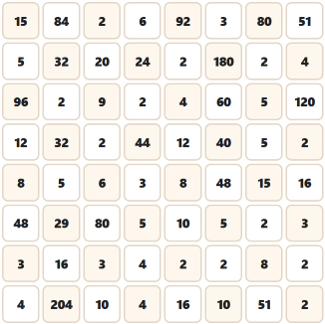
Explain that the lock number is set as 480. A valid unlock swipe uses two adjacent numbers whose product is 480.
Set the challenge:
In the previous lesson, we found that an 8 × 8 grid had 210 possible two-number swipes. On this grid, how many two-number swipes unlock the phone by producing a product of 480?
Provide students with Prime factor lock Student sheet 2 and access to the Composite factor lock digital interactive.
Allow students time to search the grid for two adjacent numbers whose product is 480 and record these swipes on their worksheet.
As students work, prompt them to think about what makes a pair worth testing.
Ask:
- Which numbers look useful? Why?
- If one number is chosen, what number would it need to sit next to?
- How could you check whether a number can be part of a product of 480?
- Are you searching row by row, around particular numbers, or in another way?
- How will you know whether you have found all possible unlock swipes?
After students have had a few minutes to start searching, pause the class briefly.
Ask:
- Is checking neighbouring pairs one by one efficient?
- How could we work out which pairs we should be looking for before checking the grid?
Draw out that each successful two-number swipe must be a factor pair of 480. If one factor is known, the matching factor can be found by dividing 480 by that number.
Model the start of a systematic list:
$$1 \times 480\\
2 \times 240\\
3 \times 160\\
4 \times 120$$
Ask:
- What number should be tested next?
- How do we know whether it is a factor of 480?
- If it is a factor, how do we find the matching factor?
- How does listing the factor pairs help with searching the grid?
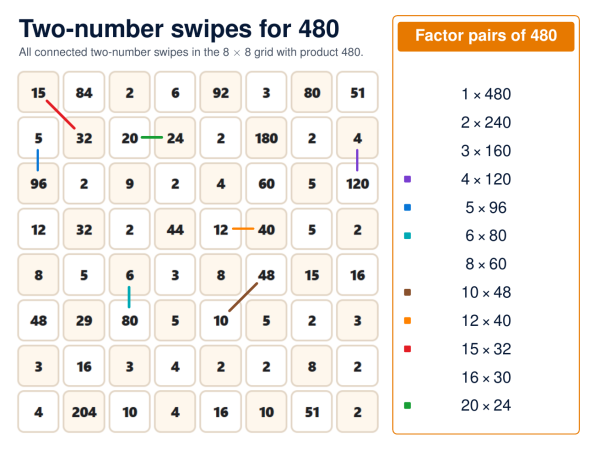
Ask students to complete the list of factor pairs of 480 on their worksheet, then return to the grid to check which factor pairs appear as adjacent numbers.
Comparing strategies for efficiency

When students begin a complex search, different approaches are likely to emerge. Some may check adjacent pairs one at a time, while others may first identify factor pairs and then look for those pairs in the grid.
Both approaches can be useful. Checking individual pairs helps students enter the problem and notice its structure. However, as the number of possible pairs grows, students need a way to reduce the search and show that their result is complete.
Before the lesson, anticipate a small number of strategies that can be compared:
- checking adjacent pairs in an unplanned order.
- using factor pairs systematically to identify which adjacent pairs are worth checking.
- finding correct examples but not yet justifying that all possibilities have been considered.
During the Explore phase, identify examples of contrasting approaches. In the Connect phase, sequence these examples so that students can see the limitations and strengths of each method.
The aim is not to announce the efficient method at the start. It is to use students’ methods to create a reason for organising the search more systematically.
Show Slide 7.
Confirm that there are 12 factor pairs of 480, but only seven appear as adjacent two-number swipes in the grid.
Discuss:
- If only seven two-number swipes work, how could the lock create more ways to unlock 480?
- What might change if the swipe could use three numbers instead of two?
Use this discussion to introduce the next exploration: students will now look for three-number swipes that multiply to 480.
Explain that the lock will now allow a swipe of three numbers. Use the toggle switch on the Composite factor lock digital interactive to switch to three-number swipes.
As before, each new number in the swipe must touch the previous number horizontally, vertically, or diagonally. The same square cannot be used twice in one swipe.
Set the challenge:
Find as many three-number swipes as possible for the lock number 480.
Ask students to record each successful three-number swipe on their worksheet.
If students are unsure how to begin, encourage them to use the two-number swipes from the previous step as a starting point.
Ask:
- Which two-number swipes for 480 might help you find a three-number swipe?
- Could one number in the swipe be replaced by two nearby numbers with the same product?
- If two numbers have already been chosen, how could you work out the third number needed?
Bring the class together and ask students to share some of the three-number swipes they found.
Record a few examples where students can explain how they found them.
Show Slide 8.
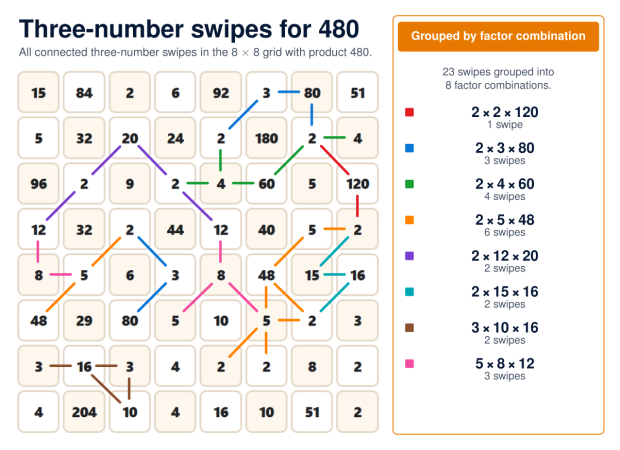
Use the slide to confirm additional three-number swipes and discuss what students notice.
Discuss:
- How were the three-number swipes connected to the factor pairs from earlier?
- How can a factor pair be turned into a three-number combination?
- What stays the same when one factor is decomposed into two smaller factors?
Draw out that a three-number combination can be generated by starting with a factor pair of 480 and decomposing one factor into two smaller factors. For example:
$12 \times 40 = 480$ and $40 = 8 \times 5$, therefore $12 \times 8 \times 5 = 480$.
Explain that this gives a useful strategy for generating three-number swipes: start with a factor pair, then split one of the factors.
Discuss:
- What might happen if we kept decomposing factors into smaller factors?
- How could this help us find even more swipes for 480?
Use this discussion to introduce the next lesson where students will investigate how many factor strings can make 480, and what happens when factors are split as much as possible.