

Number: Prime factor lock
View Sequence overviewAny natural number can be represented as a product of prime factors using exponent notation.
Prime factors can be grouped into composite factors, or composite factors can be split into prime factors, to create factor strings of different lengths that produce the same product.
Whole class
Prime factor lock Slides
Each student
Prime factor lock Student sheet 3
Prime factor lock Student sheet 4
Calculator
Task
Remind students that in the previous lesson, they found two-number and three-number swipes that produced the lock number 480.
Show Slide 10 of Prime factor lock Slides.
Explain that the design team wants to know how many different factor strings can produce 480. To investigate this, students will need to find a systematic way to generate factor strings of different lengths.
Set the challenge:
How long can a factor string for 480 be, and how can the factors of 480 help us build strings of different lengths?
Give students Prime factor lock Student sheet 3.
Explain that students need to choose two different two-number factor strings for 480 from the previous lesson. They will then decompose one composite factor at a time into smaller factors until all factors are prime.
Ask students to record each step in their breakdown and write the final prime factors in order from smallest to largest.
For example:
$$\begin{align}15 \times 32 &= 3 \times 5 \times 32\\
&= 3 \times 5 \times 2 \times 16\\
&= 3 \times 5 \times 2 \times 2 \times 8\\
&= 3 \times 5 \times 2 \times 2 \times 2 \times 4\\
&= 3 \times 5 \times 2 \times 2 \times 2 \times 2 \times 2\\
&= 2 \times 2 \times 2 \times 2 \times 2 \times 3 \times 5\end{align}$$
If students are unsure how to continue, ask:
- Which factor can still be split?
- What two factors multiply to make it?
- Which factors are prime?
Invite a few students to share the two-number factor strings they chose and how they broke them down.
As students share, record strings on the board in rows according to the number of factors. For example:
| Number of factors | Example factor strings |
|---|---|
| 2 | $15 \times 32$, $12 \times 40$ |
| 3 | $3 × 5 × 32$, $3 × 4 × 40$ |
| 4 | $3 × 4 × 5 × 8$, $2 × 2 × 3 × 40$ |
| … | … |
| 7 | $2 × 2 × 2 × 2 × 2 × 3 × 5$ |
Through the discussion draw attention to two features of the recorded strings:
- Different starting strings and different decomposition choices can produce many different factor strings with three, four, five, or six factors.
- When every factor has been decomposed as far as possible, all factors will be prime numbers and the final seven-factor string is always the same: $480 = 2 × 2 × 2 × 2 × 2 × 3 × 5$.
Draw attention to the repeated prime factors in the final string:
$$480 = 2 × 2 × 2 × 2 × 2 × 3 × 5$$
Introduce or revisit exponent notation, explaining that repeated factors can be written more compactly using powers.
Model: $2 × 2 × 2 × 2 × 2 = 2^5$
So the prime factorisation can be written as:
$$480 = 2^5 × 3 × 5$$
Draw out that the exponent 5 tells us there are five factors of 2, rather than meaning $2 × 5$.
Explain that the prime factorisation gives the fixed building blocks of 480. The next step is to work out how many different factor strings can be made by grouping those building blocks in different ways.
Return to the design problem. Explain that the phone design team needs to know how many different factor strings can produce 480 to judge whether the lock is secure enough.
Ask pairs to list as many different three-factor strings for 480 as they can. They should write the three factors within each string in ascending order, so that the same factor string written in a different order is counted only once.
For example, record $2 × 3 × 80$, but do not count $3 × 2 × 80$ as a different string.
After a short time, pause the class and ask:
- How can we be sure that all possible factor strings have been found?
- How can we avoid counting the same factor string again in a different order?
Give each student a copy of Prime factor lock Student sheet 4.
Show Slide 11. Zoom in the start (480) and then zoom out to see the resulting strings develop.
Give students a couple of minutes to look at the design of the organiser.
Discuss how the organiser is structured:
- Which factor is decomposed to create each new string?
- Why are the factors written in ascending order?
- Why do some branches stop before all the factors are prime?
- How does this structure help organise the search?
Draw out that the organiser follows a consistent method:
- Begin with a factor string written in ascending order.
- Split the final factor into two smaller factors.
- Only record a new string when all factors remain in ascending order.
- Continue until no further splits are possible while keeping the factors in ascending order. For example, $8 \times 60$ cannot be extended because 60 cannot be split into two factors that are both at least 8.
Explain that the organiser already shows the two-factor and three-factor strings for 480. Students will use it to generate the longer strings systematically.
Set the challenge:
Complete the organiser to find all factor strings for 480 with four, five, six, and seven factors. Then count how many factor strings there are of each length and calculate the total number of possible unlock strings.
Remind students that:
- a factor string must contain at least two factors.
- the factor 1 cannot be used in an unlock string.
- factor strings with the same factors in a different order are counted once only.
If students are unsure how to continue, ask:
- What is the final factor in this string?
- Which factor pairs could replace it?
- Do the factors remain in ascending order?
- Has this factor string already appeared elsewhere in the organiser?
Show Slide 12 and invite students to compare their completed organisers with the solution.
Discuss:
- How many different factor strings did you find?
- What patterns do you notice as the strings get longer?
Draw out that some string lengths produce more possibilities than others, and that longer strings become increasingly restricted by the prime factors of 480. The longest possible string contains seven factors, corresponding to the prime factorisation of 480.
Show Slide 13 and direct students to the matching table on page 2 of Prime factor lock Student sheet 4.
Explain that each row shows a possible lock number for a future factor-lock design. The table gives the prime factorisation of each number in either expanded or exponential form. The number of factor strings recorded in the table excludes the one-factor string (the lock number itself).
Ask students to work with a partner to:
- complete the missing prime products and exponential forms.
- estimate the number of factor strings each lock number might have.
- predict which lock number will have the most and fewest possible unlock strings.
Explain that the actual number of factor strings will be revealed shortly (students do not need to calculate this).
Discuss:
- Which prime factorisations seem likely to produce many factor strings? Why?
- Which lock numbers might have a similar number of factor strings?
- What features of the prime products are you using to make your predictions?
Show Slide 14 and reveal the completed table:
| Lock number | Expanded form | Exponential form | Actual number of factor strings |
|---|---|---|---|
| $432$ | $2 × 2 × 2 × 2 × 3 × 3 × 3$ | $2^4 × 3^3$ | $56$ |
| $450$ | $2 × 3 × 3 × 5 × 5$ | $2 × 3^2 × 5^2$ | $25$ |
| $480$ | $2 × 2 × 2 × 2 × 2 × 3 × 5$ | $2^5 × 3 × 5$ | $63$ |
| $512$ | $2 × 2 × 2 × 2 × 2 × 2 × 2 × 2 × 2$ | $2^9$ | $29$ |
| $672$ | $2 × 2 × 2 × 2 × 2 × 3 × 7$ | $2^5 × 3 × 7$ | $63$ |
| $2310$ | $2 × 3 × 5 × 7 × 11$ | $2 × 3 × 5 × 7 × 11$ | $51$ |
Discuss:
- Which predictions were confirmed or challenged?
- What do you notice about the prime factorisations of 480 and 672?
- What differences can you see between 480, 512 and 2310?
- What should a design team consider when choosing a lock number?
- Why might a lock number with more factor strings provide greater design flexibility but make the lock less secure?
Draw out that the number of factor strings is connected to the structure of the prime factorisation. For example, 480 and 672 have the same pattern of repeated and non-repeated prime factors, so they have the same number of factor strings.
Explain that choosing a lock number involves balancing security and design flexibility. Fewer valid factor strings mean fewer possible combinations for someone to try, while more factor strings provide greater flexibility when designing connected swipes on a grid.
Direct students to the final section of Prime factor lock Student sheet 4.
Ask students to choose a possible composite lock number below 1000 for their future design.
They should record:
- their possible lock number.
- its product of prime factors.
- its prime factorisation using exponent notation.
- a prediction about whether it will have fewer, about the same number, or more factor strings than 480.
- a brief explanation for their prediction based on the structure of its prime factorisation.
Explain that this is a provisional choice. In the final task, students will use their own factor strings organiser to test whether their chosen lock number provides enough possible unlock strings for their design.
Counting possibilities systematically
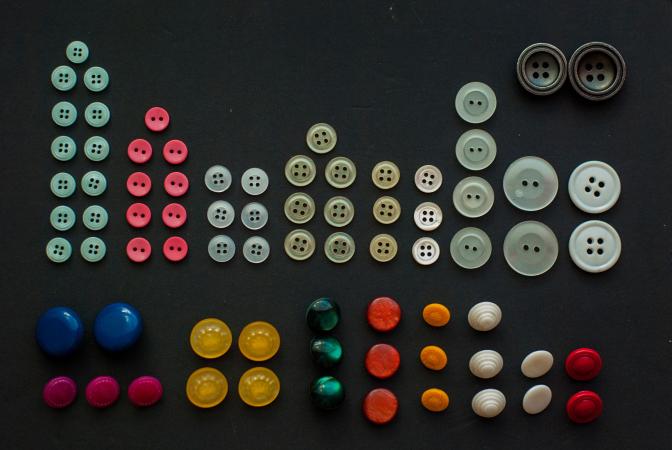
Many tasks in this sequence involve counting possibilities. The challenge is not only to obtain a total, but to organise the count so that every possibility is included once, and only once.
Students use this type of reasoning when they:
- decide what counts as a different factor string.
- determine whether order matters.
- avoid counting duplicates.
- justify that their list is complete.
In this seuqence, writing factors in ascending order provides a useful convention. For example, $2 × 3 × 80$ and $3 × 2 × 80$ represent the same factor string and should only be counted once.
Encourage students to record their work in a way that makes omissions and repetitions easier to identify. A systematic record not only supports accurate counting, but also helps students justify that their search is complete.
Prime factorisation can also help explain why different numbers may have matching numbers of factor strings. For example:
$$480 = 2^5 × 3 × 5\\
672 = 2^5 × 3 × 7$$
Although the numbers are different, they share the same prime-factor structure: one prime factor appears five times and two others appear once. Each factor string for 480 can therefore be matched with a corresponding factor string for 672 by replacing the factor 5 with 7.
This illustrates a broader idea in combinatorics: two collections can sometimes be shown to contain the same number of possibilities by matching each member of one collection with exactly one member of the other.
Discuss:
- How did prime factorisation help us understand the possible factor strings for 480?
- What method helped us find and organise factor strings without missing or repeating them?
- What will need to be considered when choosing a lock number for a new design?
Draw out the key mathematics:
- A composite number can be decomposed into its prime-factor building blocks and written using exponent notation. For example: $480 = 2^5 × 3 × 5$.
- Different factor strings are created by grouping the same prime factors in different ways.
- The number of possible multi-number factor strings depends on the structure of the lock number’s prime factorisation, not only on the size of the lock number.
Explain that many of the strategies students have used throughout this investigation are examples of computational thinking. Connect the key mathematics to computational thinking as a broader mathematical process:
- Decomposition: Breaking a lock number into smaller factors until only prime factors remain.
- Abstraction: Representing a lock number by its prime-factor structure, rather than comparing numbers only by their size.
- Algorithmic thinking: Following a repeatable method—write factors in ascending order, split the final factor, then repeat.
- Organising and checking: Recording results systematically to avoid duplicates and decide whether the search is complete.
- Pattern recognition: Using the structure of a number’s prime factorisation to predict whether it will provide enough possible factor strings.