

'Counting your odds and evens' is a reimagining of classic V8 sequence 'Odds and evens'
- On the 'In this sequence' tab you'll find all the lessons in this sequence, a suggested implementation plan and curriculum alignment.
- The 'Behind this sequence' tab shows how key mathematical ideas develop over the sequence.
- Have you taught this sequence? Use the Feedback button to let us know how it went!
Lessons in this sequence

Task 1 • Number maze
Students navigate a number maze, adding the values along their chosen path, to explore patterns in odd and even sums and make generalisations about their results.
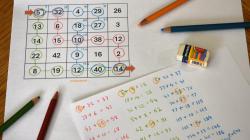

Task 2 • Designing your own maze
Students design and modify number mazes to control whether path totals are odd or even. By testing different maze designs and changing maze size, students refine their predictions about odd and even outcomes and develop an explanation for why these patterns occur.

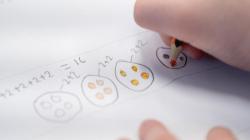
Task 3 • Explaining the pattern
Students make and defend mathematical claims about a mystery maze, using any representation they choose to explain why certain paths give odd or even totals.
The Australian Academy of Science supports and encourages broad use of its material. Unless indicated below, copyright material available on this website is licensed under a Creative Commons Attribution-NonCommercial-ShareAlike 4.0 International (CC BY-NC-SA 4.0) licence.
Curriculum and syllabus alignment
Year 4
Students use the properties of odd and even numbers.
This sequence uses number mazes to investigate the properties of odd and even numbers. Students explore why some paths through a maze always give an odd total while others do not, building towards the generalisation that whether a sum is odd or even depends only on how many odd numbers are being added, not on their size or how many numbers there are in total. In doing so, students come to see odd and even as structural properties of numbers rather than just labels, and develop skills in constructing and defending mathematical arguments using representations of their choice.
Sequence framework
This sequence framework presents an overview of the key elements in this sequence.
| Learning goals | Students’ mathematical activity | Representation | Context | |
|---|---|---|---|---|
| Task 1 | Odd and even numbers have properties that can be used to predict whether a sum will be odd or even, without calculating the total. | Students navigate a number maze, adding values along different paths, and begin to notice patterns in odd and even totals. | A 5 × 5 number maze in which students trace paths from start to finish. | Finding paths through a number maze that give an odd total. |
| Task 2 | Whether a sum is odd or even depends on the number of odd addends, not their magnitude or the total number of addends. | Students design number mazes with controlled outcomes, testing how changing numbers and maze size affects whether paths give odd or even totals. | Student-designed number mazes of varying sizes and configurations. | Designing number mazes where the odd or even outcome can be predicted and controlled. |
| Task 3 | Whether a sum is odd or even depends only on the number of odd addends. Even numbers never affect the parity of a sum. | Students construct and defend mathematical arguments about a mystery maze containing two unknown numbers, reasoning about what can be determined about each path without calculating. | A 2 × 3 mystery maze containing two unknown whole numbers. | Presenting and defending mathematical claims about paths through a mystery maze. |

'Counting your odds and evens' is a reimagining of classic V8 sequence 'Odds and evens'
- On the 'In this sequence' tab you'll find all the lessons in this sequence, a suggested implementation plan and curriculum alignment.
- The 'Behind this sequence' tab shows how key mathematical ideas develop over the sequence.
- Have you taught this sequence? Use the Feedback button to let us know how it went!