

Number: Counting your odds and evens
View Sequence overviewWe can make general claims about odd and even totals without calculating.
We can explain and justify our reasoning to others.
We can identify which numbers in a path determine whether the total is odd or even.
Whole class
Counting your odds and evens Slides
Each student
Convince me Student sheet
Always Sometimes Never Student sheet
Task
Show students the mystery maze on Slide 11 of Counting your odds and evens Slides. Explain that the two mystery squares contain whole numbers, but we do not know anything else about them.
Pose the driving question for the lesson: What can we say about each path through this maze, without knowing what the mystery numbers are?
Let students know that by the end of the lesson they will be presenting their claims to the class and trying to convince others that their reasoning is correct.
Provide groups with Convince me Student sheet, where students construct arguments for when each path might give an odd or even total. Remind them that the goal is not just to find an answer, but to build an argument they can defend.
- Are students attending to both mystery squares, or focusing on one and ignoring the other?
- Are students treating the two mystery squares as independent, or assuming they must be the same type of number?
- Are students ignoring the even numbers in the maze, or still treating all numbers as equally relevant?
- Are students making claims about specific cases (“if the orange number is 3...”) or more general claims (“if the orange number is odd...”)?
- If the orange number was 100, would that change your answer? What about 101?
- What do you already know about the numbers that aren’t mysteries? Can you start there?
- Is there a path where you can say something definite, even without knowing the mystery numbers?
- What would need to be true about the orange number for this path to give an odd total?
- Can you find two different odd numbers to try in the mystery square? Do you get the same kind of answer both times?
- Does it matter what the actual value of the mystery number is, or just whether it is odd or even?
- What happens to your claim if you swap the orange and blue mystery numbers around?
Checkpoint: After groups have had time to make at least one claim, pause the class. Ask one or two groups to share a claim they are confident about. This is not the full presentation, just a chance to check that groups are making claims about odd and even totals rather than calculating specific values.
If groups are still working with specific numbers rather than odd/even reasoning, ask: Would your claim still work if the mystery number was a different odd number?
After the checkpoint, ask groups to finalise their claims and prepare to present. Let them know they will need to be ready to respond to challenges from other groups.
Shifting from solving to designing
Asking students to design their own mazes moves the task from finding answers to constructing mathematical arguments. When designing a maze to meet a specific condition, students are forced to reason about why a maze will behave in a certain way before testing it. This is a fundamentally different cognitive demand. A student who designs a maze that always gives an odd total cannot just get lucky. They have to understand what controls the outcome well enough to build it in deliberately. In this sense, design challenges function as a form of proof: a student who can reliably construct a maze with a given property has demonstrated that they understand the underlying rule, not just that they can apply it to a single case.
Asking students to design their own mazes moves the task from finding answers to constructing mathematical arguments. When designing a maze to meet a specific condition, students are forced to reason about why a maze will behave in a certain way before testing it. This is a fundamentally different cognitive demand. A student who designs a maze that always gives an odd total cannot just get lucky. They have to understand what controls the outcome well enough to build it in deliberately. In this sense, design challenges function as a form of proof: a student who can reliably construct a maze with a given property has demonstrated that they understand the underlying rule, not just that they can apply it to a single case.
Show Slide 12 of Counting your odds and evens Slides, which includes a set of sentence starters students can use when challenging other students’ claims.
Let students know that when challenging another group, they should use these starters to make sure their challenge is mathematical:
- We’re not convinced because...
- What would happen if...?
- Can you explain why... doesn’t affect the total?
- What if the mystery number was...? Would your argument still work?
- Does your argument work for any odd number, or just that one?
- Can you show us why that’s always true, not just sometimes?
Invite groups to present their findings by stating their claim first, then showing a specific path from the maze as an example that supports it. Other students can then challenge or build on what they hear using the sentence starters.
Invite groups to present their findings by stating their claim first, then showing a specific path from the maze as an example that supports it. Other students can then challenge or build on what they hear using the sentence starters.
| Argument | Challenge |
| This path that avoids the two mystery numbers always gives an odd total because the numbers on it add to 23, which is odd. | We agree that this path is always odd. Can you find another path that also gives an odd total and explain what they have in common? |
| If the orange number is odd, this path gives an even total, because 7 and the orange number cancel out. | Can you explain what you mean by cancel out? Does that work for any odd number, or just that one? |
| The even numbers don’t matter at all. You only need to look at the odd numbers. | What would happen if you replaced 12 with 13? Would your argument still work? |
| It depends on whether the mystery number is odd or even, not what the actual number is. | Can you explain why? For example, why would you get the same result whether the orange number was 1 or 99? |
Convince me: supporting mathematical argumentation

A “convince me” activity asks students to do something genuinely difficult: not just reach a correct answer but construct a reasoned argument and respond to challenges from peers. Before presentations begin, it is worth spending two or three minutes explicitly naming three types of response students might give:
- Disputing without reasoning: “That’s wrong” without explanation. This shuts down discussion without advancing anyone's thinking.
- Agreeing without reasoning: “We think the same” without being able to say why.
- Reasoned challenge: “We’re not convinced because...” followed by a specific mathematical reason, a counterexample, or a question that probes the argument.
A strong mathematical argument in this task has three parts: a claim (e.g. this path always gives an odd total), evidence (e.g. we tried it with three different odd numbers), and a reason connecting the two (e.g. because no matter what odd number you use, something is always left over that cannot be paired). Listen for whether student arguments include all three and use questions to draw out any that are missing.
Consider establishing the following norms before presentations begin:
- We challenge the argument, not the person.
- A good challenge includes a reason or a question, not just a disagreement.
- Being convinced by another group and changing one’s mind is a sign of good mathematical thinking, not a defeat.
A “convince me” activity asks students to do something genuinely difficult: not just reach a correct answer but construct a reasoned argument and respond to challenges from peers. Before presentations begin, it is worth spending two or three minutes explicitly naming three types of response students might give:
- Disputing without reasoning: “That’s wrong” without explanation. This shuts down discussion without advancing anyone's thinking.
- Agreeing without reasoning: “We think the same” without being able to say why.
- Reasoned challenge: “We’re not convinced because...” followed by a specific mathematical reason, a counterexample, or a question that probes the argument.
A strong mathematical argument in this task has three parts: a claim (e.g. this path always gives an odd total), evidence (e.g. we tried it with three different odd numbers), and a reason connecting the two (e.g. because no matter what odd number you use, something is always left over that cannot be paired). Listen for whether student arguments include all three and use questions to draw out any that are missing.
Consider establishing the following norms before presentations begin:
- We challenge the argument, not the person.
- A good challenge includes a reason or a question, not just a disagreement.
- Being convinced by another group and changing one’s mind is a sign of good mathematical thinking, not a defeat.
Ask students to complete the Always sometimes never Student sheet individually.
Bring the class back together. Show the incomplete statements on Slide 13 and invite students to help complete each statement:
- A path will always give an even total if... there is an even number of odd numbers.
- A path will always give an odd total if... there is an odd number of odd numbers.
Invite students to justify each statement. Draw out explicitly that even numbers in a path never affect the result, only the odd numbers matter, and only how many of them there are, not what their value is.
Conclude by summarising: Whether a total is odd or even depends entirely on how many odd numbers are added. Even numbers can always be ignored.
Adding odd and even numbers
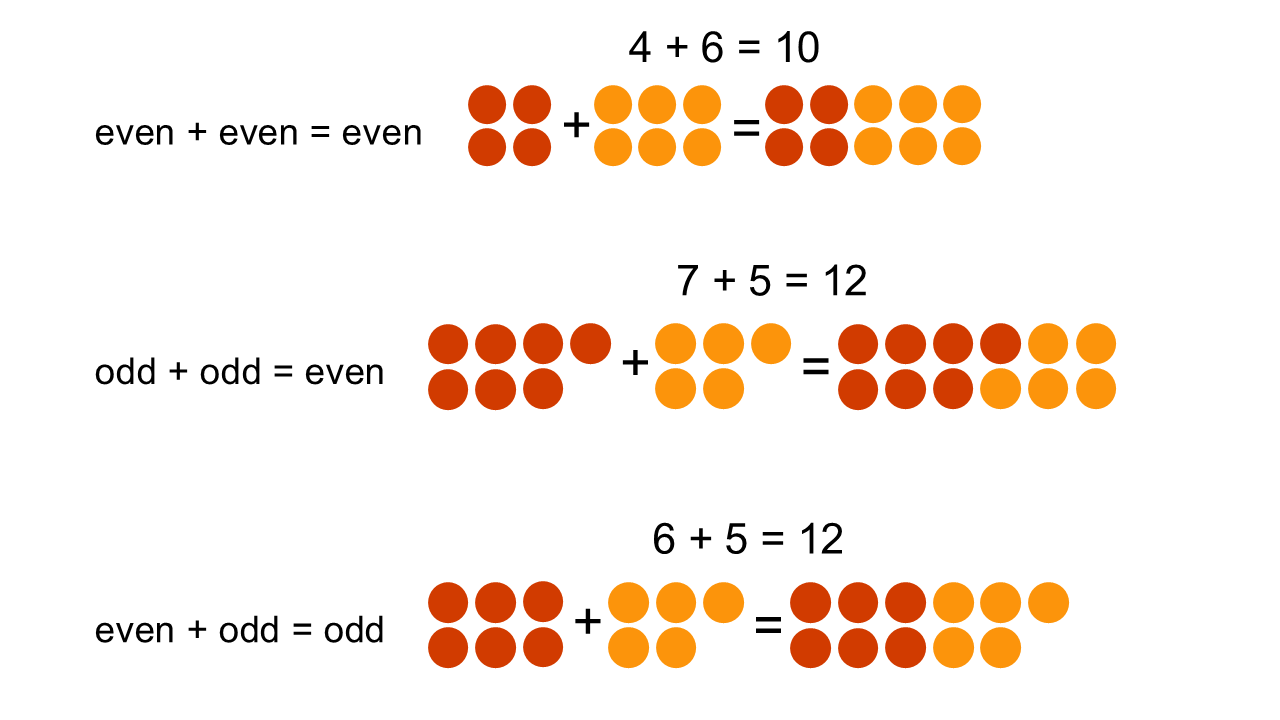
An odd number of odd addends is always required for a sum to be odd. This result arises from the underlying structure of odd and even numbers.
An even number of objects can be arranged into pairs with nothing left over. An odd number of objects always leaves one unpaired. When odd numbers are combined, their unpaired objects find each other and form new pairs. The total is odd only when an odd number of unpaired objects remain after all possible pairings.
Representing numbers in two rows provides a helpful way to illustrate this structure, making the pairing that defines oddness and evenness visible.
Consider $4 + 6$, $7 + 5$ and $6 + 5$ in the splash image above.
This helps explain the general case:
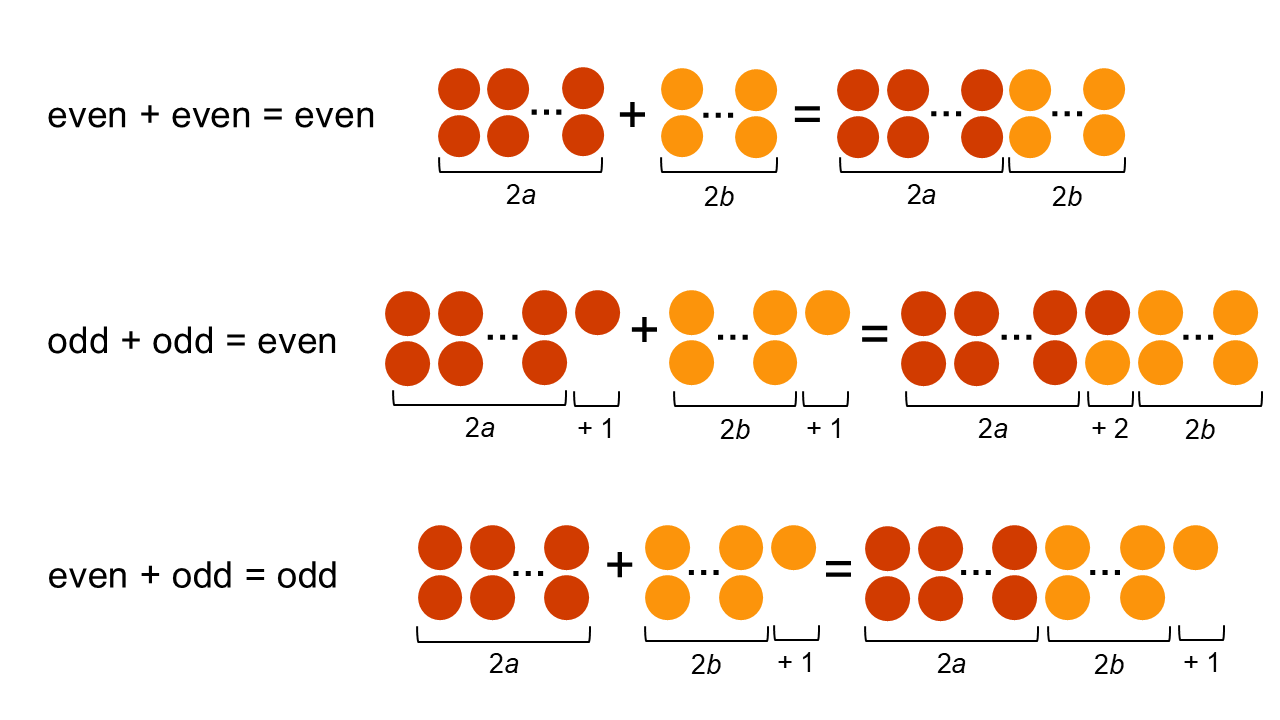
An odd number of odd addends is always required for a sum to be odd. This result arises from the underlying structure of odd and even numbers.
An even number of objects can be arranged into pairs with nothing left over. An odd number of objects always leaves one unpaired. When odd numbers are combined, their unpaired objects find each other and form new pairs. The total is odd only when an odd number of unpaired objects remain after all possible pairings.
Representing numbers in two rows provides a helpful way to illustrate this structure, making the pairing that defines oddness and evenness visible.
Consider $4 + 6$, $7 + 5$ and $6 + 5$ in the splash image above.
This helps explain the general case: