

Number: Recurring decimals, or just the wrong base?
View Sequence overviewA fraction can be represented by either a terminating decimal or a recurring decimal.
A fraction’s denominator determines whether its decimal representation terminates or recurs.
Each group
Fraction sort Student sheet
Blank fraction sort Student sheet
Scissors
Calculator
Task
Write on the board: $\frac{1}{4}$ and $\frac{1}{3}$.
Ask students to convert both fractions to decimals. Record: $\frac{1}{4}=0.25$ and $\frac{1}{3}=0.333\ldots$
Introduce notation for recurring decimals: a dot above the digit (or digits) is used to show digits that repeat. For example, $0.333\ldots$ is written $0.\dot{3}$, and $0.142857142857\ldots$ is written $0.\dot{1}4285\dot{7}$.
Introduce the terms “terminating decimal” and “recurring decimal”.
Ask:
- What is different about these two decimal representations?
- Why does one terminate while the other recurs?
- Without calculating, what do you think might determine whether a fraction terminates or recurs?
Working in small groups, provide students with the Fraction sort Student sheet, which contains fraction cards with space to record each fraction’s decimal representation.
Students calculate the decimal representation of each fraction (either by hand or with a calculator) and sort the cards into two groups: terminating and recurring.
If students use a calculator, remind them that the display shows a rounded approximation rather than the complete decimal representation. For example, $\frac{1}{6}$ may appear as $0.1666666667$ rather than an endless string of sixes. Where a digit or block of digits continues for the remainder of the display, students should record the decimal using recurring notation (for example, $0.1\dot{6}$).
Once the cards have been sorted, shift attention from the decimal representations to the fractions themselves. Ask students to look for patterns that might explain why some fractions have terminating decimal representations and others have recurring decimal representations.
- Pick two fractions in the same group. What do you notice about their denominators? Their numerators?
- If you already know $\frac{1}{5}$ terminates, does that tell you anything about $\frac{2}{5}$ or $\frac{3}{5}$, without calculating them?
- Could you predict whether $\frac{7}{20}$ terminates, without working it out?
- Given what you know about these fractions, can you come up with another fraction that will terminate? One that won’t?
- What information would you need to predict whether a new fraction will terminate or recur without converting it to a decimal?
Checkpoint: Pause the class and ask one or two groups to briefly share what they have noticed so far. If no group has moved beyond simply sorting, ask: Did anyone notice anything about fractions with the same denominator?
Return students to the task with a new challenge: Can you explain what determines whether a simplified fraction has a terminating or recurring decimal representation?
Hand out blank cards from the Blank fraction sort Student sheet and invite students to create fractions that test their emerging ideas. Encourage students to look for examples that support their conjecture, as well as examples that might challenge it.
| Students notice… | How to respond |
|---|---|
| “$\frac{1}{4}$ terminates but $\frac{1}{3}$ doesn’t.” | Ask: Can you find any other fractions that behave the same way as $\frac{1}{4}$? As $\frac{1}{3}$? |
| “The numerator doesn’t seem to matter. $\frac{2}{3}$ and $\frac{1}{3}$ both recur, and $\frac{3}{4}$ and $\frac{1}{4}$ both terminate.” | Ask: Does this always hold? What about $\frac{3}{3}$ or $\frac{2}{6}$? Guide toward: the numerator doesn’t matter as long as the fraction is in its simplest form. |
| “Anything with a denominator of seven recurs. $\frac{1}{7}$ and $\frac{2}{7}$ are both in the recurring group.” | Good pattern recognition. Ask: Can you find other denominators where this holds? |
| “The even denominators seem to terminate.” | Only partly true: $\frac{1}{6}$’s decimal recurs. Ask: can you find a counterexample? |
| “If the denominator is prime, it recurs. Except for two and five.” | Ask: Why might two and five be different from other primes? |
| “I think $\frac{7}{20}$ will terminate because 20 is related to four and five, which both terminate.” | Predictive thinking. Ask: Can you write a rule that would let you predict any fraction? |
Checkpoint

A checkpoint is a brief pause during an exploration phase where the class comes together to share interim progress. It is not a summary: the task continues afterwards. The purpose is to give students a chance to see how others are approaching the problem, surface useful ideas that have emerged, and maintain momentum.
In this task, the checkpoint serves two specific functions. First, it creates an opportunity to shift students who are still at the level of individual observations (e.g. “$\frac{1}{5}$ terminates, $\frac{1}{7}$ doesn’t”) towards noticing something structural about the denominators, without the teacher needing to intervene with every group. Second, selecting students to share in order from least to most sophisticated gives the whole class access to a progression of thinking, so that the conjecture-writing that follows feels like a natural next step.
Converting fractions to decimals: calculator or by hand?
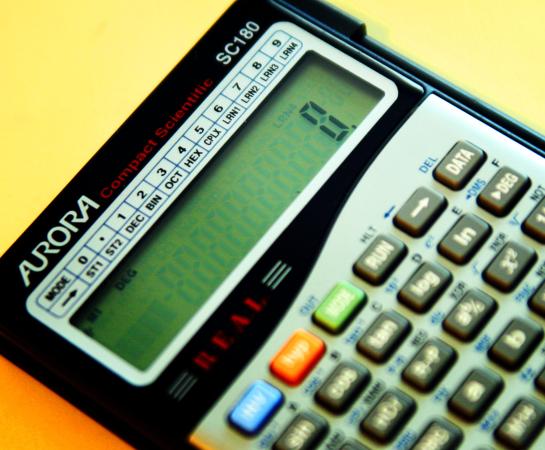
Students can convert fractions to decimals either by hand or with a calculator. A calculator is the better choice for most of this task: the goal is noticing patterns across the full set of fractions, and a calculator speeds up that process.
That said, having students convert a few fractions by hand is worth the time. A calculator can show that a decimal recurs, but a hand calculation helps explain why it recurs. Take $\frac{1}{3}$: dividing one by three, the remainder is one, then one again, then one again, forever, so the digit 3 keeps coming back for exactly the same reason each time.
Converting two or three fractions by hand, particularly $\frac{1}{3}$ and $\frac{1}{7}$, are enough to build this intuition. Once students have seen how recurring decimals arise from repeating remainders, a calculator can be used for the remaining fractions so attention can shift to looking for patterns and building a conjecture.
Bring together the ideas that were generated during the investigation. Students might have noticed that:
- the numerator does not seem to affect whether a decimal representation terminates or recurs.
- many fractions with even denominators terminate, but not all.
- fractions with prime denominators usually recur, except for two and five.
Ask: If we put everyone’s observations together, what conjecture could we make about when a simplified fraction has a terminating decimal representation?
Work as a class towards a single combined statement, then test the conjecture against a few counterexamples, refining it as needed until it holds up as the class’s best working conjecture. Ideally this should be something like: A simplified fraction has a terminating decimal representation when two and five are the only prime factors of its denominator.
| If the class suggests… | Test it with… |
|---|---|
| ...that all fractions with even denominators have terminating decimals. | $\frac{1}{6}$ (decimal recurs, even denominator) |
| ...that fractions with prime denominators always have recurring decimals. | $\frac{1}{2}$ and $\frac{1}{5}$ (both have terminating decimals, both prime denominators) |
| ...that fractions whose denominators are multiples of five will have terminating decimals. | $\frac{1}{15}$ ($15 = 3 \times 5$, so the denominator contains a prime factor other than two or five) |
| ...any unsimplified fractions that don’t fit the rule. | $\frac{3}{15}$ (the denominator includes a factor of three, so its decimal looks like it should recur. But $\frac{3}{15}$ simplifies to $\frac{1}{5}$, and $\frac{1}{5} = 0.2$, a terminating decimal) |
Once the conjecture has survived testing, discuss how the class’s conjecture is more than a description of the fractions they tested. It provides a way to predict whether a simplified fraction will have a terminating decimal representation without first converting it to a decimal.
Close with the open question: Why are two and five the only factors that matter? What’s special about those two numbers?
Ensure that students keep their completed cards from Fraction sort Student sheet for use next lesson.
Testing and refining conjectures

Mathematical discoveries rarely begin with a proof. More often, mathematicians notice patterns, propose conjectures, then test and refine them against new examples. Lakatos’ Proofs and Refutations (1976) traces this as the actual history of mathematical discovery: ideas rarely arrive fully formed and proven, they’re built through cycles of conjecturing and revising against counterexamples. Mason, Burton, and Stacey’s Thinking Mathematically (2010) frame this more directly as a set of habits, specialising (trying particular cases), conjecturing, and convincing, that describe how mathematical thinking actually unfolds.
School mathematics often presents results as already settled: rules to apply rather than claims someone once had to test. Giving students the chance to build their own conjecture, and to have it survive (or not survive) a few counterexamples, is a chance to practice the discipline of mathematics itself.
References
Lakatos, I. (1976). Proofs and Refutations: The Logic of Mathematical Discovery. Cambridge University Press.
Mason, J., Burton, L., & Stacey, K. (2010). Thinking Mathematically (2nd ed.). Pearson.