

Number: Recurring decimals, or just the wrong base?
View Sequence overviewBinary numbers can have a fractional part, just like base 10 decimals do.
A simplified fraction has a terminating decimal representation in binary when its denominator is a power of two.
Each group
Completed cards from Fraction sort Student sheet from Task 1
Device with access to Wolfram Alpha
Task
Ask students if they’ve ever seen a calculator or computer get a simple calculation wrong. If no one has, demonstrate it live by opening an internet browser, right-clicking anywhere on a webpage, and choosing Inspect.

Open the Console tab.

Type 0.1 + 0.2 and press Enter. The result isn’t 0.3, it’s 0.30000000000000004.
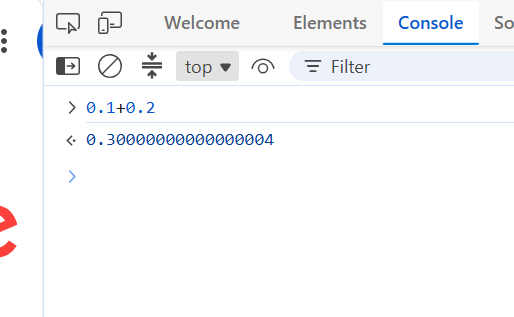
A browser console or a Python shell can both be used to demonstrate this live.
Excel and Google Sheets should be avoided for this demonstration. Both use the same underlying arithmetic as a browser console, but round displayed results to around 15 significant figures, so 0.1 + 0.2 will display as 0.3.
A standard calculator app should also be avoided. Most calculator apps use decimal-based arithmetic rather than binary arithmetic so 0.1 + 0.2 is calculated as exactly 0.3, not just displayed that way.
Explain that computers store numbers in binary. Some fractions that have terminating decimal representations in base 10 have recurring representations in binary. A recurring representation continues indefinitely, so it cannot be stored exactly using a finite number of digits. Because computers can only store a finite number of binary digits, values such as $\frac{1}{10}$ must be rounded. The small error introduced by that rounding is what leads to results such as 0.1 + 0.2 = 0.30000000000000004.
Pose the problem: Why does a fraction such as $\frac{1}{10}$ have a terminating decimal representation in base 10, but a recurring representation in binary? What changes when the fraction is written in a different base?
If needed, spend a short amount of time revisiting binary place value for whole numbers. A working understanding of what a binary number represents is enough, and fluency in converting or calculating by hand isn’t necessary. See the embedded professional learning Cross-curricular connection with digital technologies below for further advice regarding teaching binary.
Cross-curricular connection with digital technologies

In the Year 7 and 8 Digital Technologies curriculum, AC9TDI8K04 asks students to explain how and why digital systems represent integers in binary. This lesson extends that idea into fractional territory by asking what comes after the radix point in binary (“radix point” is the general term for a decimal point).
If students are encountering binary for the first time in this lesson, the recap will need more time than allocated. In this case, consider coordinating with the Digital Technologies teacher before running this lesson, so students arrive with the integer binary knowledge already in place. If that’s not possible and you need to teach binary as part of the lesson, Exploding Dots from the Global Math Project is a visual “dot and box” model for place value across any base that is worth a look.
When rounding recurring decimals has real consequences

Because computers can only store finite binary decimals, a recurring binary decimal must be rounded, and in 1991 that rounding contributed to a missile defence failure.
A Patriot missile defence system in Dhahran, Saudi Arabia, measured time in tenths of a second. To convert those counts into elapsed time, the system repeatedly used the value $\frac{1}{10}$. The problem is that $\frac{1}{10}$ has a recurring representation in binary, so it could not be stored exactly. Instead, the computer stored a rounded approximation.
Each individual error was tiny, but the system operated continuously for more than 100 hours. Over time, those tiny errors accumulated. By the time the attack occurred, the timing error had grown to 0.34 seconds. At the speed of the incoming Scud missile, this shifted the system’s predicted position by more than half a kilometre. The Patriot system failed to track the missile correctly, and no interceptor was launched. The missile struck an Army barracks, killing 28 soldiers on 25 February 1991.
This is an extreme example, but it illustrates an important lesson: recurring representations are not merely a mathematical curiosity. In computer systems, even very small rounding errors can sometimes have significant real-world consequences.
Further reading
For the official account of the failure, see the GAO report IMTEC-92-26: Patriot Missile Defense: Software Problem Led to System Failure at Dhahran, Saudi Arabia.
For a detailed walkthrough of the binary expansion of $\frac{1}{10}$ and the accumulated error calculation, see The Patriot Missile Failure by Douglas N. Arnold.
Practice: Binary place value
Draw a place value chart on the board with the columns after the point left blank.
| 4s | 2s | 1s | . | $\frac{1}{2}$s | $\frac{1}{4}$s | $\frac{1}{8}$s | $\frac{1}{16}$s |
|---|---|---|---|---|---|---|---|
| . |
Ask: What should the column immediately to the right of the point be worth?
Since each column is worth half of the column to its left, this column is worth $\frac{1}{2}$. Label it on the chart.
Ask students to determine the value of the remaining columns. Each new column is worth half of the one to its left.
This step is optional. It provides students with an opportunity to see how binary representations are constructed and why some representations terminate while others recur. Wolfram Alpha can be used for the main investigation regardless.
Write the fraction $\frac{3}{8}$ on the board.
Remind students that a binary number after the point is a sum of place-value columns (halves, quarters, eighths, sixteenths, and so on), each either used once or not at all. Converting a fraction to binary means determining which columns combine to make the target fraction.
Explain: Starting with the largest place-value column and working down, check whether each column fits into the fraction that remains. If it does, record a 1 and subtract its value. If it does not, record a 0 and move to the next column.
Starting with $\frac{3}{8}$:
- Does $\frac{1}{2}$ fit into $\frac{3}{8}$? No, write 0 in the halves column.
- Does $\frac{1}{4}$ fit into $\frac{3}{8}$? Yes, write 1 in the quarters column and subtract $\frac{1}{4}$ from $\frac{3}{8}$, leaving $\frac{1}{8}$.
- Does $\frac{1}{8}$ fit into the remaining $\frac{1}{8}$? Yes, write 1 in the eighths column and subtract $\frac{1}{8}$, leaving 0.
The binary representation is therefore $0.011_2$ (the subscript 2 denotes that this number is in base 2).
Now try $\frac{1}{3}$.
Following the same process produces the digits 0, 1, 0, 1, ... and the pattern continues indefinitely. The binary representation therefore recurs.
Investigation
In Task 1, students investigated whether fractions terminated or recurred in base 10. This investigation asks a new question: What happens to those same fractions when they are represented in binary?
Ask students to draw a large version of the following grid.
| Terminates in binary | Recurs in binary | |
|---|---|---|
| Terminates in base 10 | ||
| Recurs in base 10 |
Demonstrate how to convert a fraction into binary using Wolfram Alpha by entering a query such as: “What is 5/12 in base 2?”
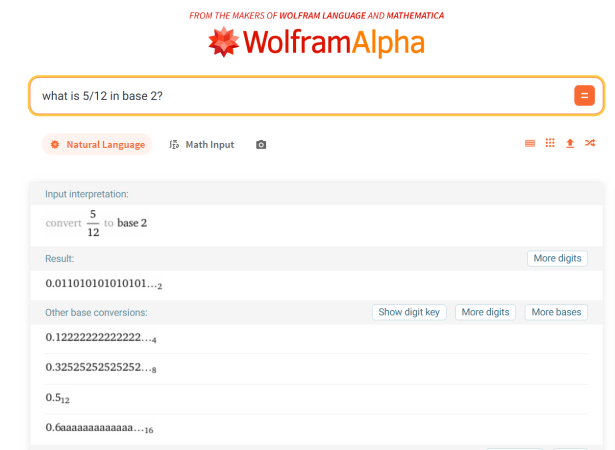
Students revisit the fraction cards from their Fraction sort Student sheet. They should convert each fraction into binary and then place it into the appropriate quadrant of the grid.
Encourage students to pay particular attention to fractions that change status when the base changes.
Discuss:
- Which quadrants are filling most quickly?
- Is any quadrant empty?
- Which fractions changed status when the base changed?
- Which fractions stayed the same?
Encourage students to test fractions beyond the provided cards, gathering more and more data until a conjecture starts to take shape.
| Students notice… | How to respond |
|---|---|
| “One quadrant is empty, nothing recurred in base 10 but terminated in binary.” | This is true for any fraction. Ask: Can anyone find a new fraction that would break this? Why might that quadrant always stay empty? |
| “Every card in the ‘terminates in base 10 but recurs in binary’ quadrant has a denominator that’s a multiple of five.” | Ask: Look at everything in the “terminates in both” quadrant, then everything in “terminates in base ten only.” What do you notice comparing the two groups? |
| “Every card that terminates in binary has a denominator that’s a power of two.” | Ask: Can you find a fraction that terminates in binary whose simplified denominator is not a power of two? What does it mean if you can’t? |
| “All the fractions with prime denominators stayed recurring.” | Ask: Is that true for every prime you tested, including two and five? What happens to fractions with those denominators? |
Decimal point or radix point?

The word “decimal” comes from the Latin word for ten, so the term “decimal point” technically applies only to base 10. In other bases, the more general term is “radix point”.
This distinction highlights an important idea in this sequence: the places to the right of the point are determined by the base being used. In base 10, the places represent tenths, hundredths, and thousandths. In binary, they represent halves, quarters, eighths, and so on.
This sequence avoids introducing radix point as formal vocabulary. What matters is not the terminology itself, but the idea that the point separates the whole-number part from the fractional part, and that the value of each fractional place depends on the base being used.
Remind the class of the conjecture they built during Task 1, for example: A simplified fraction has a terminating decimal representation when the only prime factors of its denominator are two and five.
Ask:
- What did our investigation reveal about that conjecture?
- The conjecture does not describe what happens in binary. Some fractions that terminate in base 10 recur in binary.
- Does that mean our conjecture was wrong?
- The conjecture still describes what happens in base 10. The issue is not that the conjecture was wrong, but that it was specific to base 10.
- What conjecture would better describe what happens in binary?
- Work as a class towards a new conjecture, something like: A simplified fraction has a terminating representation in binary when its denominator is a power of two.
Test the class’s conjecture against a range of examples and counterexamples, refining it as needed until it holds up as the class’s best working conjecture.
| If the class says… | Respond with… |
|---|---|
| “It terminates for denominators like 2, 4, 8, 16...” (a list, not a rule) | What do those denominators have in common? Is there a way to describe that without listing them? |
| “It terminates when the denominator has a factor of two and a factor of five, just like base 10.” | Test with $\frac{1}{20}$ (denominator $2^2 \times 5$), whose decimal recurs in binary but terminates in base 10. |
| “It terminates whenever the denominator has a factor of two” or “whenever it’s even”. | Is having a factor of two sufficient, or does every factor need to be two? Point back to $\frac{1}{6}$: it has a factor of two, but its decimal still recurs. A factor of two alone isn’t sufficient. |
| “It terminates as long as the denominator doesn’t include a factor of five.” | Point back to $\frac{1}{6}$ or $\frac{1}{3}$: neither has a factor of five, and both still have recurring decimals. Avoiding a factor of five isn’t sufficient either. |
Discuss:
- How is this conjecture similar to the one we developed for base 10?
- How is it different?
- Why might powers of two matter specifically in binary?
Close by noting that the lesson has produced two different rules, one for base 10 and one for binary.
Leave the class with the question: Could there be a single rule that explains both?