

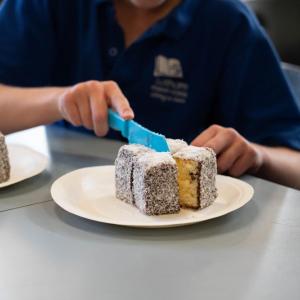
'Fractions: Lamington slice' is a reimagining of classic V8 sequence 'Lamingtons'
- On the 'In this sequence' tab you'll find all the lessons in this sequence, a suggested implementation plan and curriculum alignment.
- The 'Behind this sequence' tab shows how key mathematical ideas develop over the sequence.
- Have you taught this sequence? Use the Feedback button to let us know how it went!
Lessons in this sequence

Task 1 • Where will you stand?
Students explore fractions as division through a whole-class problem, where they choose to stand at one of three tables to receive a share of lamingtons. Students then calculate and compare each person’s share.


Task 2 • Sharing lamingtons
Students compare how different numbers of lamingtons are shared among four groups of students, using unit fractions to determine whether any group receives a larger share.

Task 3 • Equal shares
Students apply their knowledge of fractions as division/a quotient to determine a more equal way to share the lamingtons across all four groups.

This sequence has been designed for Year 5 students and assumes some prior understanding of the concepts of unit fractions and equivalent fractions, as well as division as sharing.
Suggested implementation
This time plan is just one way that you might choose to implement this sequence. Task 1 of the sequence may be taught as a double lesson or taught over two separate 50 minute lesson periods.
The timing provided in the tasks’ documentation align with this implementation advice. This is one way that you might implement this sequence.
| Monday | Task 1 • Where will you stand?
|
| Tuesday | Task 1 • Where will you stand?
|
| Wednesday | Task 2 • Sharing lamingtons
|
| Thursday | Task 3 • Equal shares
|
The Australian Academy of Science supports and encourages broad use of its material. Unless indicated below, copyright material available on this website is licensed under a Creative Commons Attribution-NonCommercial-ShareAlike 4.0 International (CC BY-NC-SA 4.0) licence.
Curriculum and syllabus alignment
Year 5
By the end of Year 5, students order and represent, add and subtract fractions with the same or related denominators.
Number
Compare and order fractions with the same and related denominators including mixed numerals, applying knowledge of factors and multiples; represent these fractions on a number line
Solve problems involving addition and subtraction of fractions with the same or related denominators, using different strategies
Check and explain the reasonableness of solutions to problems including financial contexts using estimation strategies appropriate to the context
Use mathematical modelling to solve practical problems involving additive and multiplicative situations including financial contexts; formulate the problems, choosing operations and efficient calculation strategies, using digital tools where appropriate; interpret and communicate solutions in terms of the situation
Fractions embody multiple related concepts and can be represented in various ways. Students often find fractions challenging because they may not yet have developed a strong conceptual understanding of the different meanings that fractions can convey. In addition, students frequently apply whole-number reasoning when working with fractions, interpreting the numerator and denominator as separate values rather than as components of a single numerical quantity (Van de Walle, Karp, & Bay-Williams, 2014).
Fraction notation can be particularly complex for students to understand, as it simultaneously represents both a number and an operation.
As a number, fraction notation:
- expresses a fixed value.
- represents a position on a number line.
- indicates magnitude.
As an operation, fraction notation:
- expresses $\frac{a}{b}$ is equivalent to $a \div b$.
A deep understanding of fractions requires attention to several interconnected interpretations:
- Part-whole: partitioning a whole into equal parts
- Measure: representing a quantity relative to a unit
- Quotient/Division: sharing equally to determine the size of each part
- Operator: acting on a quantity (e.g. finding a fraction of a set)
- Ratio: expressing relationships between parts and/or the whole
(Van de Walle, Karp, & Bay-Williams, 2014)
To develop robust fractional understanding, students need opportunities to explore these multiple meanings and to make connections among different fraction constructs. This sequence emphasises fractions as quotients, highlighting that the notation $\frac{a}{b}$ is equivalent to $a \div b$. This perspective connects fractions to the concept of equal sharing, where the numerator and denominator together express a relationship between part and whole.
Sequence framework
| Learning goals | Students’ mathematical activity | Representation | Context | |
|---|---|---|---|---|
| Task 1 | Fractions represent division. A fraction connects the number of items being shared (numerator) and the number of equal parts. (denominator). | Students learn that fractions represent division. They explore efficient strategies to determine equal shares where the result is a fraction. | Fair shares are represented visually as a fraction and recorded using fraction notation. The written fraction represents the connection the number of items being shared and the number of shares. | Share a particular number of lamingtons between differing numbers of students, to determine which group of students get the largest fraction of lamington. |
| Task 2 | Unit fractions have a numerator of one. The larger the denominator the smaller the fraction. A fraction is a number that can be ordered on a number line. | Students explore efficient strategies to compare fractional quantities. They learn that unit fractions are fractions with a numerator of one, which can be used to compare quantities. | Fractions represent division, and the number of items is divided by the number of shares. The vinculum of a fraction separates the numerator and the denominator and signals division. | Share a particular number of lamingtons into fractions which can be compared to find which group gets the largest share. |
| Task 3 | A fraction is a number. Fractions represent division. A fraction is an equal share. | Students apply their knowledge of fractions as division and unit fractions to determine the most fair/equal share. They recognise fractions represent division, and that fraction is an equal share. | Represent sharing as division, using drawings, division equations and fraction notation. | Using division to share all of the lamingtons with the whole class to determine what fair/equal share students get. |
References
Van de Walle, J., Karp, K. S., & Bay-Williams, J. M. (2014). Elementary and middle school mathematics. Pearson.

'Fractions: Lamington slice' is a reimagining of classic V8 sequence 'Lamingtons'
- On the 'In this sequence' tab you'll find all the lessons in this sequence, a suggested implementation plan and curriculum alignment.
- The 'Behind this sequence' tab shows how key mathematical ideas develop over the sequence.
- Have you taught this sequence? Use the Feedback button to let us know how it went!