

Fractions: Lamington slice
View Sequence overviewA fraction is a number.
Fractions represent division.
A fraction is an equal share.
Whole class
Lamingtons slice Slides
Task
Re-Launch: Review the previous lesson: We found that it was easier to compare unit fractions as they all have a numerator of 1. We can order unit fractions from largest to smallest by comparing denominators because we know that the bigger the denominator the smaller the fraction.
Show slide 16 of the Lamingtons slice Slides. Discuss how the slide shows two different sharing strategies, but students get an equivalent fraction of lamington.
Draw students’ attention to the size of the fractions $\frac{1}{2}$, $\frac{1}{5}$, and $\frac{1}{10}$, noting that each denominator is larger than the previous one.
Show slide 17 to discuss how some students got more lamington than other students.
- Five students share three lamingtons to get $\frac{3}{5}$ or $\frac{1}{2} + \frac{1}{10}$.
- Five students share four lamingtons to get $\frac{4}{5}$ or $\frac{1}{2} + \frac{1}{10} + \frac{1}{5}$.
- Six students share five lamingtons to get $\frac{5}{6}$ or $\frac{1}{2} +\frac{1}{3}$.
- Eight students share six lamingtons to get $\frac{6}{8}$ or $\frac{1}{2} + \frac{1}{4}$.
Ask students which groups got more lamington and to explain their reasoning.
Introduce the idea of fair or equal shares and briefly invite students to share examples of their own experience. For example, sharing at home or cutting fruit.
Pose the task: If the lamingtons were shared equally across the groups, how much would each student receive?
Unit fractions as the building blocks of all fractions
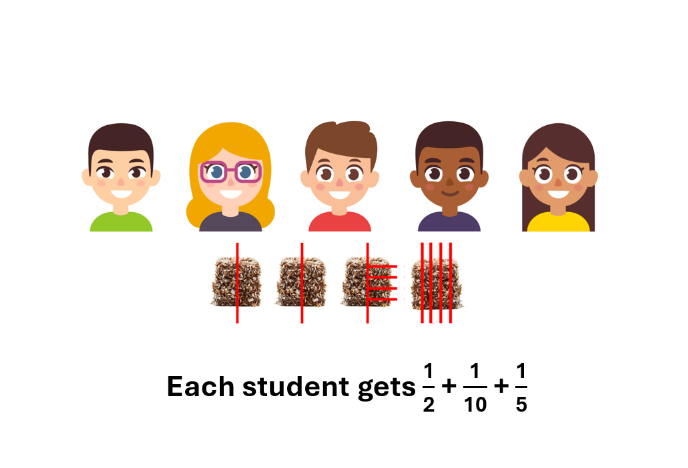
All fractions are the sum of unit fractions. This can be seen using the strategy that systematically divides the lamingtons into unit fractions. The lamingtons are divided into the largest fraction to share between the students, then the remaining lamingtons are continuously shared into progressively smaller unit fractions.
This is a helpful strategy as students can compare the unit fractions to find who has the larger share. Task 2 showed that comparing unit fractions can be helpful because you only need to compare the denominators, as the numerators are all 1. Understanding that the larger the denominator, the smaller the fraction, allows students to determine which fraction is larger.
The picture above shows three lamingtons shared between five students as follows:
- Three lamingtons are divided into two (half is the largest unit fraction) to make six halves.
- Each student receives one half, which leaves one and a half lamingtons to divide between the five students.
- The whole lamington is divided between the five students, who each receive one fifth.
- The remaining half lamington is divided between the five students who each receive one tenth, as this is a fifth of a half, which can be seen in the picture.
This can be expressed using unit fractions as $\frac{4}{5} = \frac{1}{2} + \frac{1}{10} + \frac{1}{5}$.
This method is more practical for sharing and shows that any unit fraction can be split into smaller unit fractions, which can be expressed as the sum of those unit fractions.
All fractions are the sum of unit fractions. This can be seen using the strategy that systematically divides the lamingtons into unit fractions. The lamingtons are divided into the largest fraction to share between the students, then the remaining lamingtons are continuously shared into progressively smaller unit fractions.
This is a helpful strategy as students can compare the unit fractions to find who has the larger share. Task 2 showed that comparing unit fractions can be helpful because you only need to compare the denominators, as the numerators are all 1. Understanding that the larger the denominator, the smaller the fraction, allows students to determine which fraction is larger.
The picture above shows three lamingtons shared between five students as follows:
- Three lamingtons are divided into two (half is the largest unit fraction) to make six halves.
- Each student receives one half, which leaves one and a half lamingtons to divide between the five students.
- The whole lamington is divided between the five students, who each receive one fifth.
- The remaining half lamington is divided between the five students who each receive one tenth, as this is a fifth of a half, which can be seen in the picture.
This can be expressed using unit fractions as $\frac{4}{5} = \frac{1}{2} + \frac{1}{10} + \frac{1}{5}$.
This method is more practical for sharing and shows that any unit fraction can be split into smaller unit fractions, which can be expressed as the sum of those unit fractions.
Organise students into small groups to find what fraction each student receives when 18 lamingtons are shared between 24 students. Provide each student with a sheet of A3 paper to record their thinking and to represent their group’s work as a poster.
Possible student strategies and teacher questions:
- Students may cut each lamington into 24 pieces.
- Is it practical to cut one lamington into 24 pieces?
- What might be more practical?
- Students may find the total number of lamingtons and students, then share all the lamingtons between all the students.
- How many lamingtons are there altogether and how many students do you have to share them between? (18 lamingtons between 24 students)
- Students may divide each lamington in half and then share the remaining lamingtons.
- What fraction does each student receive?
- $\frac{1}{2} + \frac{1}{4}$
- How much of one lamington would this be?
- $\frac{2}{4} + \frac{1}{4} = \frac{3}{4}$
- What fraction does each student receive?
Enabling prompts
- What does it mean to share equally?
- How could the lamington pictures help you?
- Can you describe the problem in your own words?
- Do you have enough lamingtons for students to get a whole one each? How do you know?
Extending prompts
- How do you know how much each student gets? What information does the fraction give you?
- How do you know who has the largest fraction?
- How could you represent this with a diagram, words, or a number sentence?
- How does a fraction show division?
- Can you solve this in more than one way?
- What would happen if you were sharing the same number of lamingtons between 15 students?
Select student work samples that illustrate different sharing strategies and have used mathematical and fractional notation.
Differentiation
Teachers differentiate tasks to support students to engage in learning, but this does not mean planning different activities for different students. This task can be differentiated to support students who need enabling and those who need extending.
| Support | Challenge | |
|---|---|---|
| Content: what the student needs to learn. | Visual cues to prompt students (task information on class board). Cut out lamington sheets or fraction models to physically divide the lamingtons. Extra work time. | Encourage students to use symbolic fractions, division notation and simplified fraction. Students select their own numbers of lamingtons and students. |
| Process: the mathematical activity students engage in. | Access to concrete materials to support their reasoning. Represent through partitioning, drawing and materials to model sharing. Flexible grouping where students can learn from peers and engage in discussion. | Represent division and fraction reasoning using symbolic expressions. Justify reasoning and record as simplest fraction, explaining equivalence. |
| Product: what students do to practise, apply or extend their understanding. | Options of how to express their learning. For example, labelled models and diagrams of action of division and fraction each students gets. | Express thinking using multiple representations, clarifying the connections between the different models. Clarify how they simplified the final fraction. |
| Learning environment: classroom norms developed. | Diversity is valued and strengthens our learning community. Every student has the potential to learn, grow and succeed. Everyone's ideas, perspectives and contributions are respected. High expectations support all students to achieve their best. | |
References
Tomlinson, C. A. (2014). The differentiated classroom: Responding to the needs of all learners. ASCD.
Teachers differentiate tasks to support students to engage in learning, but this does not mean planning different activities for different students. This task can be differentiated to support students who need enabling and those who need extending.
| Support | Challenge | |
|---|---|---|
| Content: what the student needs to learn. | Visual cues to prompt students (task information on class board). Cut out lamington sheets or fraction models to physically divide the lamingtons. Extra work time. | Encourage students to use symbolic fractions, division notation and simplified fraction. Students select their own numbers of lamingtons and students. |
| Process: the mathematical activity students engage in. | Access to concrete materials to support their reasoning. Represent through partitioning, drawing and materials to model sharing. Flexible grouping where students can learn from peers and engage in discussion. | Represent division and fraction reasoning using symbolic expressions. Justify reasoning and record as simplest fraction, explaining equivalence. |
| Product: what students do to practise, apply or extend their understanding. | Options of how to express their learning. For example, labelled models and diagrams of action of division and fraction each students gets. | Express thinking using multiple representations, clarifying the connections between the different models. Clarify how they simplified the final fraction. |
| Learning environment: classroom norms developed. | Diversity is valued and strengthens our learning community. Every student has the potential to learn, grow and succeed. Everyone's ideas, perspectives and contributions are respected. High expectations support all students to achieve their best. | |
References
Tomlinson, C. A. (2014). The differentiated classroom: Responding to the needs of all learners. ASCD.
The purpose of this Connect phase is for students to:
|
Select students to reflect on strategies that made it easier to compare each group’s fraction.
Invite these students to share:
- why they used that strategy.
- how they solved the problem to get their fraction.
- which fraction/s they found and what information this gave them.
Discuss as a class:
- How are these strategies different?
- How are they similar?
- What is an equal share of the lamingtons for 24 students?
- How can the same share be expressed using different fractions?
- What connections do you notice between $18 \div 24$ and $\frac{3}{4}$?
Encourage students to consider:
- division as sharing equally.
- a fraction as an equal share.
- how some ways of writing fractions show the relationship between fractions and division. For example, when two lamingtons are divided between three people, each person gets $\frac{2}{3}$.
Ask: How would you explain the connection between division and fractions to a student in another class?