

Fractions: Lamington slice
View Sequence overviewUnit fractions have a numerator of 1.
The larger the denominator, the smaller the fraction.
A fraction is a number that can be ordered on a number line.
Whole class
Lamingtons slice Slides
Each student
A3 paper
Optional: Lamingtons Sheet
Task
Re-Launch: We found that we can represent division as a fraction. Some ways of dividing the lamingtons make it easier to compare the fractions each student gets.
Discuss the strategies that students used to share the lamingtons in the previous task.
Introduce the example of a class of 24 students who are doing the same lamington activity as your students did in Task 1. They have four tables at the front of the room, each with a different number of lamingtons:
- three lamingtons on the first table.
- four lamingtons on the second table.
- five lamingtons on the third table.
- six lamingtons on the fourth table.
The 24 students came into the room one at a time and chose where to stand.
Show students slide 7 of the Lamington slice Slides.
Pose the task: What share of lamington does each student in each group get?Who gets the most? How do you know?
Organise students into small groups. Provide each student with a sheet of A3 paper and ask them to represent how much lamington each student at each table gets using diagrams, numbers and/or words to clearly show their thinking.
If students wish to physically divide the lamington pictures, as in the first task, provide them with multiple Lamington Sheets.
Allow students time to work through the task.
- How have you shared the lamingtons between the students in this group?
- Do students in any one group get more or less than one whole lamington? Why do you think this?
- Do the students in any one group get the same share of lamington as the students in another group?
- How could you compare which students got the largest share of lamington?
Students may use some of the sharing strategies from the previous task.
- Students divide each lamington into the same number of parts as students. For example, for five students shared three lamingtons equally, each lamington is cut into fifths, and each student gets $\frac{1}{5}$ of each lamington. This means each student will get three $\frac{1}{5}$s of a lamington, or $\frac{3}{5}$.
- Students divide the lamingtons into halves and share these equally. The students then cut the remaining halves into smaller parts and share these parts. For example, for four children shared three lamingtons equally, each lamington is split in half, and each student gets $\frac{1}{2}$ of a lamington. The final two halves are split in half again to create four quarters, and each student gets $\frac{1}{4}$ of a lamington. This means each student will get $\frac{3}{4}$ of a lamington.
- Students may directly compare fraction sizes.
- Students use a number line to compare the size of unit fractions.
Use a Checkpoint here to choose and show examples of student work illustrating different ways of dividing the lamingtons into fractions. Ask students to notice how they have shared the lamingtons and any strategies that are different to their own.
As students compare their strategy to the strategies of other groups, ask them to ponder:
- How is this strategy different to what I have done?
- Is it easier to compare who gets the largest share using my strategy or another strategy? Why?
Following this, allow students time to revisit and revise their own work based on what they’ve seen or heard.
Checkpoint
A checkpoint is a brief, purposeful pause in learning where the teacher highlights examples of student thinking to support collective understanding.
During this checkpoint, the teacher selects and shares student work that illustrates key mathematical ideas related to fractions as division and comparing fractions. The goal is to make effective strategies visible and help students refine their thinking.
Possible strategies to highlight:
- Strategy 1: Fractions as division/a quotient—Students represent sharing by dividing each lamington into the same number of parts as there are students.
- While this shows a strong understanding of fractions as division, students using this approach may find it more challenging to compare fractions when both the numerator and denominator differ.
- Strategy 2: Partitioning into unit fractions—Students divide each lamington into unit fractions (fractions with a numerator of 1), starting by dividing in half as this is the largest unit fraction.
- This supports easier comparison, as unit fractions can be ordered by size.
- A number line can be used to organise and compare these unit fractions effectively.
The checkpoint supports students in:
- comparing their approaches with others and gathering new ideas if they are unsure how to proceed.
- listening to and learning from peers’ explanations and reasoning.
- refocusing on the key mathematics and the problem being solved.
Use the checkpoint to address common misconceptions. For example, some students may focus on fairly sharing the lamingtons but overlook the need to compare which group receives the largest share.
A checkpoint is a brief, purposeful pause in learning where the teacher highlights examples of student thinking to support collective understanding.
During this checkpoint, the teacher selects and shares student work that illustrates key mathematical ideas related to fractions as division and comparing fractions. The goal is to make effective strategies visible and help students refine their thinking.
Possible strategies to highlight:
- Strategy 1: Fractions as division/a quotient—Students represent sharing by dividing each lamington into the same number of parts as there are students.
- While this shows a strong understanding of fractions as division, students using this approach may find it more challenging to compare fractions when both the numerator and denominator differ.
- Strategy 2: Partitioning into unit fractions—Students divide each lamington into unit fractions (fractions with a numerator of 1), starting by dividing in half as this is the largest unit fraction.
- This supports easier comparison, as unit fractions can be ordered by size.
- A number line can be used to organise and compare these unit fractions effectively.
The checkpoint supports students in:
- comparing their approaches with others and gathering new ideas if they are unsure how to proceed.
- listening to and learning from peers’ explanations and reasoning.
- refocusing on the key mathematics and the problem being solved.
Use the checkpoint to address common misconceptions. For example, some students may focus on fairly sharing the lamingtons but overlook the need to compare which group receives the largest share.
The purpose of this Connect phase is for students to:
|
Select examples of students’ work which show different ways of sharing the lamingtons.
Invite selected students to share their strategies and the fractions they found.
Discuss student strategies, focusing on:
- how students divided the lamingtons and represented this as a fraction.
- how students compared the fractions to find out who got the most and to justify their reasoning.
Show slides 8-13, which demonstrate different strategies for sharing the lamingtons. Ask the students to notice how the strategies are different and discuss what they notice about the fractions that are made.
Show slide 14 and explain that the number line is a helpful way to compare whether a fraction is closer to zero or one whole. Discuss which unit fractions are greater or smaller than $\frac{1}{2}$.
Use the number line on slide 14 to establish which unit fractions students understand to be greater or smaller than $\frac{1}{2}$. Some students may have a whole-number understanding of fractions, where they believe $\frac{1}{4}$ is greater than $\frac{1}{2}$ because 4 is bigger than 2. It can be powerful to fold strips of paper into halves, thirds and quarters to demonstrate that the bigger the denominator, the smaller the fraction. The more pieces the whole is cut into, the smaller each fraction. Strips can be connected to represent fractions greater than 1.
Discuss:
- Which strategy makes it easier to compare the fractions to see who has more? Why?
- Which students get more lamington?
Explain: One way to compare fractions is to use unit fractions that have a numerator of 1. This lets us focus on the denominator to find who has the largest share. The more pieces the whole is divided into, the smaller the fraction. So, the bigger the denominator, the smaller the share you get.
Fraction benchmarks on a number line
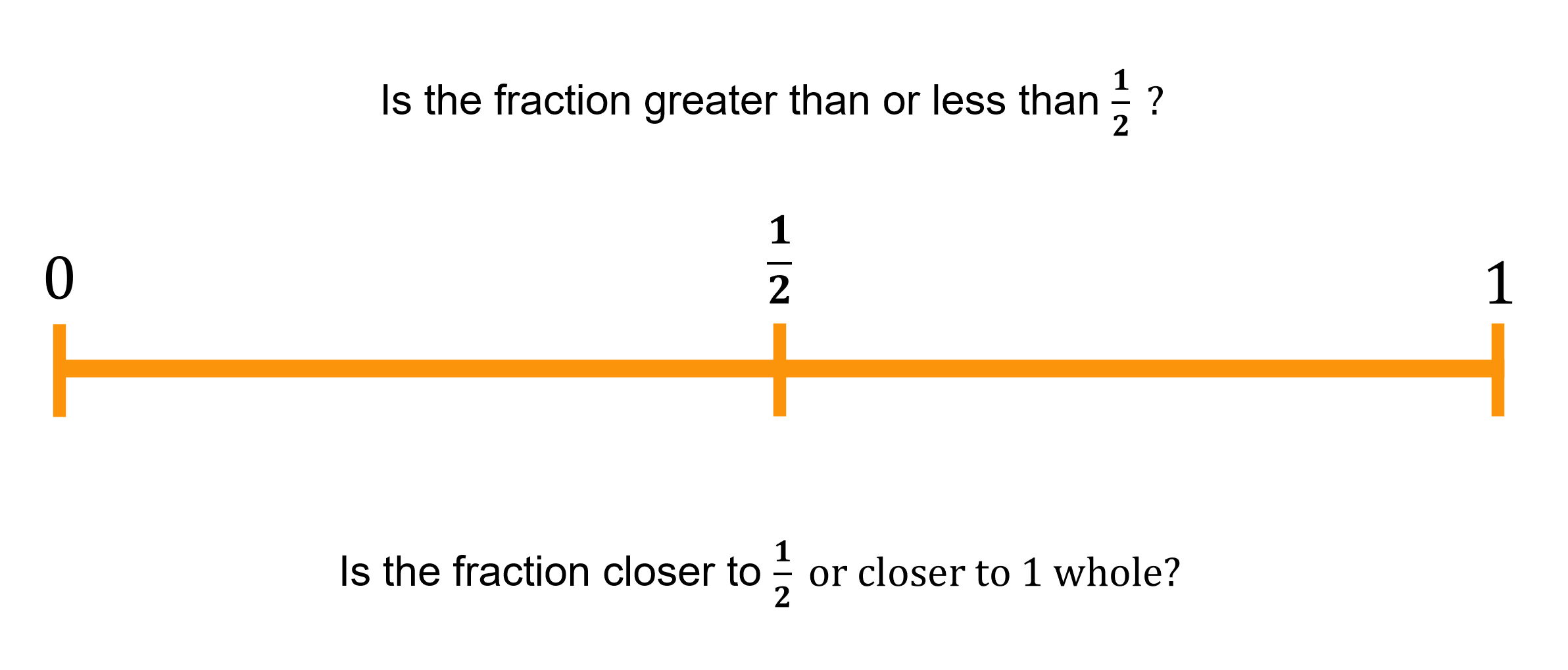
A number line is a powerful visual tool for helping students understand and compare unit fractions (fractions with a numerator of 1, such as $\frac{1}{2}$, $\frac{1}{3}$ and $\frac{1}{4}$).
In the Connect phase, the number line supports students to link new learning about fractions to their existing knowledge of numbers. By representing fractions on a number line, key ideas such as partitioning, relative size, and magnitude become visible and meaningful.
Students are already familiar with using number lines for whole numbers. Extending this representation helps them see fractions as measurable quantities with a fixed position on a number line, rather than just two numbers written as a pair. This is important because students may initially rely on whole-number thinking, for example, assuming $\frac{1}{2}$ is smaller than $\frac{1}{4}$ because 2 is less than 4. Placing these fractions on a number line makes the inverse relationship clear: for unit fractions, the larger the denominator, the smaller the fraction.
Using a number line also focuses attention on the distance from zero. Smaller unit fractions are positioned closer to 0, while larger ones are farther away. Fixing the whole as the interval from 0 to 1 ensures that comparisons are consistent and meaningful. The number line can also continue beyond a whole for fractions larger than 1.
On a number line, the fraction farther to the right is greater, and for unit fractions, the more parts the whole is divided into, the smaller each part becomes. Over time, this supports students to develop a mental number line, which is an internal representation that allows them to estimate and reason about the size and position of fractions without calculation.
This foundation is critical for later learning, including decimals, percentages and proportional reasoning as students build an understanding of relationships between parts and wholes.
A number line is a powerful visual tool for helping students understand and compare unit fractions (fractions with a numerator of 1, such as $\frac{1}{2}$, $\frac{1}{3}$ and $\frac{1}{4}$).
In the Connect phase, the number line supports students to link new learning about fractions to their existing knowledge of numbers. By representing fractions on a number line, key ideas such as partitioning, relative size, and magnitude become visible and meaningful.
Students are already familiar with using number lines for whole numbers. Extending this representation helps them see fractions as measurable quantities with a fixed position on a number line, rather than just two numbers written as a pair. This is important because students may initially rely on whole-number thinking, for example, assuming $\frac{1}{2}$ is smaller than $\frac{1}{4}$ because 2 is less than 4. Placing these fractions on a number line makes the inverse relationship clear: for unit fractions, the larger the denominator, the smaller the fraction.
Using a number line also focuses attention on the distance from zero. Smaller unit fractions are positioned closer to 0, while larger ones are farther away. Fixing the whole as the interval from 0 to 1 ensures that comparisons are consistent and meaningful. The number line can also continue beyond a whole for fractions larger than 1.
On a number line, the fraction farther to the right is greater, and for unit fractions, the more parts the whole is divided into, the smaller each part becomes. Over time, this supports students to develop a mental number line, which is an internal representation that allows them to estimate and reason about the size and position of fractions without calculation.
This foundation is critical for later learning, including decimals, percentages and proportional reasoning as students build an understanding of relationships between parts and wholes.