

Fractions: Lamington slice
View Sequence overviewFractions represent division.
A fraction connects the number of items being shared (numerator) and the number of equal shares (denominator).
Whole class
Lamington slice Slides
6 lamingtons
3 separate tables/chairs/surfaces
Each student
Lamingtons Sheet
A3 paper
Glue stick
Scissors
Sticky notes
Task
Explain that you are going to place some lamingtons on three tables. Ten students will then take turns to choose which table to stand at. The students at each table will divide the lamingtons at their table fairly between themselves. The aim is to be at the table which gets the largest share of lamingtons.
Select ten students to go outside the room, or to the back of the room, so that they cannot see the tables.
Place three tables at the front of the room and place a different number of lamingtons on each table:
- one lamington on the first table.
- two lamingtons on the second table.
- three lamingtons on the third table.
One at a time, invite each of the selected students to the front of the class to choose a table to stand at. Remind them that once they have chosen a table they must remain at that table.
When eight students have chosen a table to stand at, ask the rest of the class to consider where they think the last two students would choose to stand and why. Student suggestions might include:
- the table with the most lamingtons, as they assume that students will get more because there are more lamingtons to share.
- This works at the start, but the share gets smaller as more students join.
- the table with the fewest students, as they will get a larger portion of each lamington because the lamingtons are being shared with fewer students.
- This works at the start, but the share gets smaller if more students join.
- the last two students should choose their tables to make sure that they balance students already at the tables.
- A similar number of students at each table ensures that the students at the table with the most lamingtons will get the larger share.
Invite the remaining two students to choose where to stand. Make a note of:
- the number of students at each table.
- the number of lamingtons.
Record this somewhere, such as a classroom whiteboard, for it to be clearly seen.
Pose the task: Find out how much lamington each student at each different table gets. On which table did students get the most lamington? Explain why they got the most.
Organise students into small groups. Provide each student with a sheet of A3 paper, a Lamingtons Sheet, a pair of scissors and a glue stick.
Explain that students are going to use the information recorded on the board to find how much lamington each of the students at each table get and what the largest share is.
Students use the pictures on Lamingtons Sheet to support their thinking about the problem. They may represent their reasoning in any way they choose to create a poster of their mathematical thinking, which includes:
- the number of students and the number of lamingtons.
- their strategy for sharing/dividing the lamingtons on each table between the students.
- the fraction of lamington that each table of students will receive.
- which table of students gets the most lamington each and why.
- Students may divide each lamington into the number of students there are at each table.
- Students may divide each lamington into halves to share between the number of students, and then cut the remaining halves into smaller parts to share these.
- Students may assume that a student with multiple pieces of lamington gets more than a student with one piece.
- Students may record the activity as a division operation.
- Students may understand that the number of lamingtons divided by the number of students can be expressed as a fraction.
- How have you shared the lamingtons?
- If a student has multiple pieces of lamington, do they have more than a student who just has one piece of lamington? Why do you think that?
- At each table, what fraction of the lamingtons does each student get? How do you know?
- Which table of students get the most lamington? How can you compare them accurately?
- What do you notice about the number of shares and the size of each share?
- Can you explain a way of knowing the fraction each student gets without calculating?
You may choose to Spotlight student strategies that may benefit the whole class.
Ask students to display their posters in preparation for the gallery walk.
Fractions and division
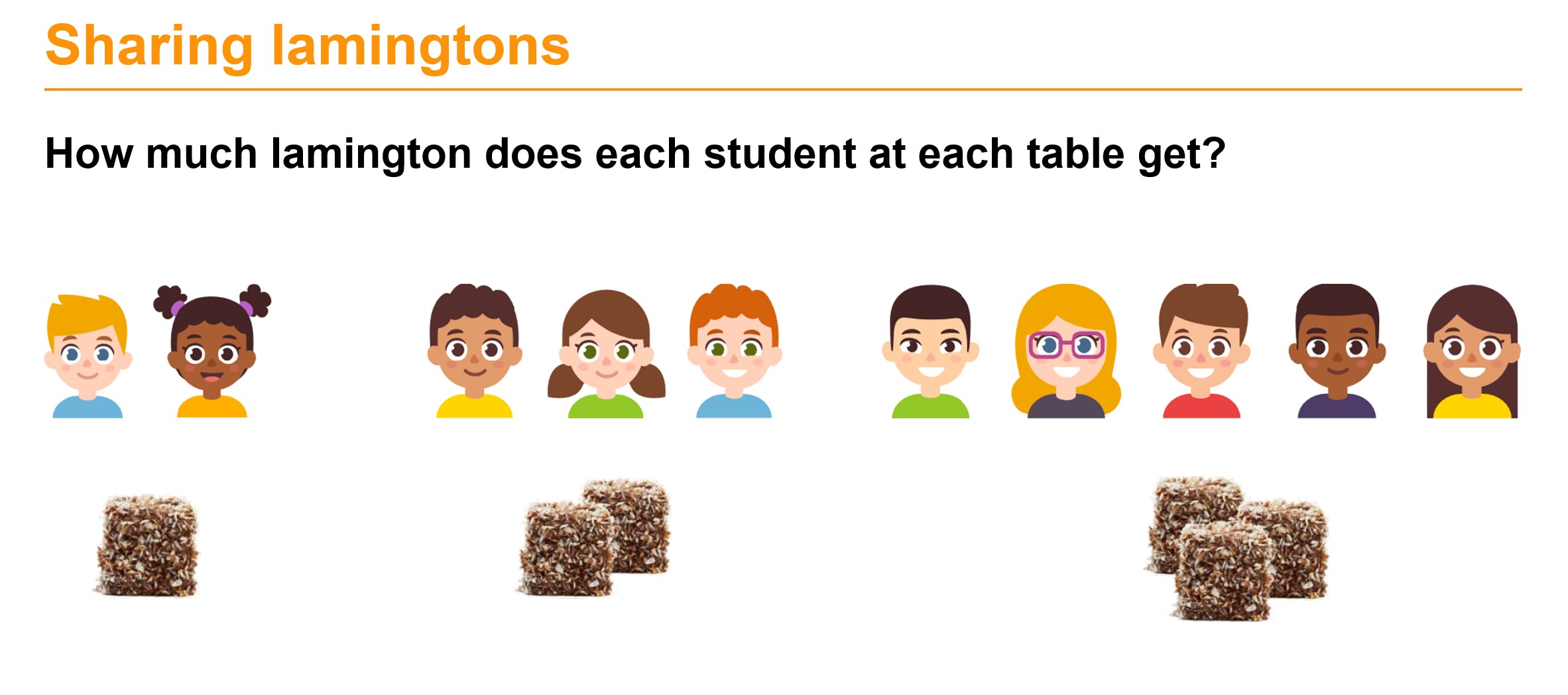
This task is designed for students to use the lamington pictures to support their thinking about the problem. During this Explore phase, students physically divide up the lamingtons to share them, which allows different strategies to emerge through their activity.
There are two likely strategies that students will use.
Strategy 1
Strategy 1 shows a fraction as division or as a quotient.
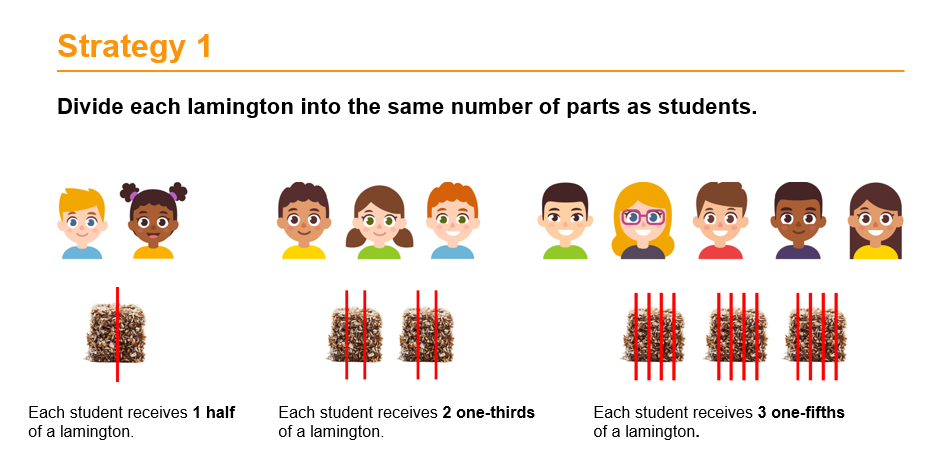
In this strategy, students directly divide each piece between the number of students. There is a clear relationship between the number of lamingtons shared, the number of students the lamingtons are divided between and the portion each student receives. For example:
- When 1 lamington is shared between 2 students, the share/fraction each student receives is $\frac{1}{2}$. This can be recorded as $1 \div 2 = \frac{1}{2}$.
- When 2 lamingtons are shared between 3 students, the share/fraction each student receives is $\frac{2}{3}$. This can be recorded as $2 \div 3 = \frac{2}{3}$.
- When 3 lamingtons are shared between 5 students, the share/fraction each student receives is $\frac{3}{5}$. This can be recorded as $3 \div 5 = \frac{3}{5}$.
Strategy 2
Strategy 2 divides the lamingtons into unit fractions.
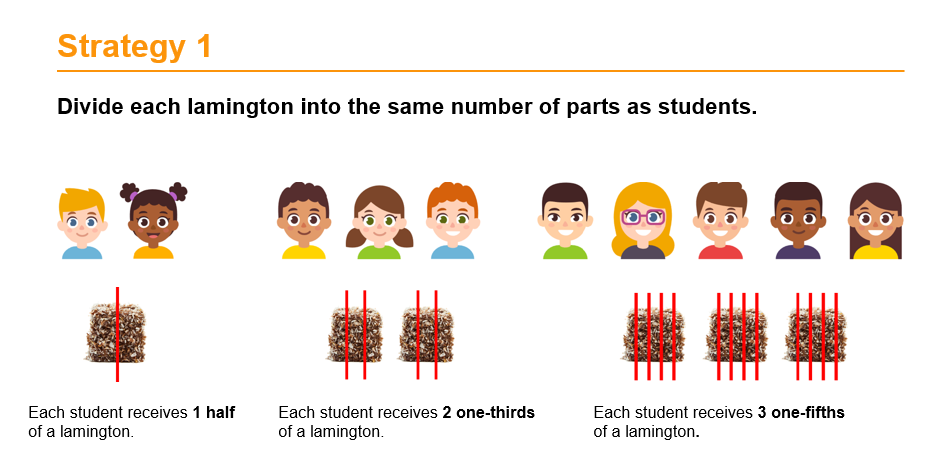
The lamingtons are shared into the largest unit fraction which can be shared between the students, then subsequently into smaller unit fractions. This is an efficient way of sharing as the unit fractions can be compared on a number line to find out which students got the largest share.
Unit fractions
The University of Cambridge nrich maths website has rich, engaging mathematics resources which focus on problem solving. Their resource Egyptian Fractions explores how the ancient Egyptians represented all fractions as the sum of unit fractions.
The Equivalent fractions embedded PL below details how these different strategies represent fractions that are equivalent.
This task is designed for students to use the lamington pictures to support their thinking about the problem. During this Explore phase, students physically divide up the lamingtons to share them, which allows different strategies to emerge through their activity.
There are two likely strategies that students will use.
Strategy 1
Strategy 1 shows a fraction as division or as a quotient.
In this strategy, students directly divide each piece between the number of students. There is a clear relationship between the number of lamingtons shared, the number of students the lamingtons are divided between and the portion each student receives. For example:
- When 1 lamington is shared between 2 students, the share/fraction each student receives is $\frac{1}{2}$. This can be recorded as $1 \div 2 = \frac{1}{2}$.
- When 2 lamingtons are shared between 3 students, the share/fraction each student receives is $\frac{2}{3}$. This can be recorded as $2 \div 3 = \frac{2}{3}$.
- When 3 lamingtons are shared between 5 students, the share/fraction each student receives is $\frac{3}{5}$. This can be recorded as $3 \div 5 = \frac{3}{5}$.
Strategy 2
Strategy 2 divides the lamingtons into unit fractions.
The lamingtons are shared into the largest unit fraction which can be shared between the students, then subsequently into smaller unit fractions. This is an efficient way of sharing as the unit fractions can be compared on a number line to find out which students got the largest share.
Unit fractions
The University of Cambridge nrich maths website has rich, engaging mathematics resources which focus on problem solving. Their resource Egyptian Fractions explores how the ancient Egyptians represented all fractions as the sum of unit fractions.
The Equivalent fractions embedded PL below details how these different strategies represent fractions that are equivalent.
Re-Launch: If this phase happens in the subsequent lesson, briefly review last lesson’s mathematical task that was posed and ask students to think about what they expect to see as they complete the gallery walk. If you are continuing the current Explore phase, move straight into the gallery walk.
Provide each student with some sticky notes to write feedback and questions about what they see.
Ask students to consider the following questions as they look at others’ work:
- What do you notice that is the same about how students have shared the lamingtons? What do you notice that is different?
- Which strategy/strategies do you find most helpful for working out the share that each student gets? Why?
- Which strategy do you find most helpful for finding which group of students each get the largest share?
Conduct the class gallery walk.
At the end of the class gallery walk, allow students time to read and reflect on any sticky notes left on their work.
Select student posters which use different strategies to discuss during the Connect phase.
Gallery walk

A gallery walk is an activity where students move around the room to examine and reflect on other students’ mathematical work. The role of students is not just to observe, but to critically view, compare and evaluate different approaches.
During a gallery walk, students are encouraged to think beyond their own strategy. They consider how their approach is similar to or different from others, and how different representations help to communicate mathematical ideas. This broadens their understanding and supports them to see that there are multiple valid ways to solve a problem.
In this task, students focus on how different groups have approached the problem of sharing lamingtons. They are asked to:
- identify similarities and differences between strategies.
- consider which strategies make it easier to see whether the shares are fair.
- evaluate which approaches are most helpful for determining which group receives the largest share.
Through this process, students develop their understanding of fractions as division and the different ways that they can divide a quantity.
A gallery walk is an activity where students move around the room to examine and reflect on other students’ mathematical work. The role of students is not just to observe, but to critically view, compare and evaluate different approaches.
During a gallery walk, students are encouraged to think beyond their own strategy. They consider how their approach is similar to or different from others, and how different representations help to communicate mathematical ideas. This broadens their understanding and supports them to see that there are multiple valid ways to solve a problem.
In this task, students focus on how different groups have approached the problem of sharing lamingtons. They are asked to:
- identify similarities and differences between strategies.
- consider which strategies make it easier to see whether the shares are fair.
- evaluate which approaches are most helpful for determining which group receives the largest share.
Through this process, students develop their understanding of fractions as division and the different ways that they can divide a quantity.
The purpose of this Connect phase is for students to:
|
Invite selected students to share their work and explain their strategy and thinking.
Reflect on the different strategies students noticed during the gallery walk.
Discuss:
- Did you see a strategy that was helpful for working out the share that each student got? Why do you think this?
- Some examples of student strategies might include:
- cutting each lamington up to match the number of students so each piece can be counted out and shared.
- cutting each lamington into half and sharing the halves equally, then cutting the remaining lamington halves into enough smaller parts for each student.
- noticing a relationship between the number of lamingtons and the number of shares and connecting this with fraction notation.
- Some examples of student strategies might include:
- Which strategy made it easier for you to compare who got a bigger fraction? Why do you think it made it easier to compare the fractions?
- Students may think:
- it is hard to compare different sized shares.
- the student with most parts gets most.
- Students may think:
- Can you find the fraction each student will get without working it out?
- Some students may have noticed the connection between:
- the number of lamingtons.
- the number of students who get a share.
- the fraction notation.
- Some students may have noticed the connection between:
Show slides 3-5 of Lamington slice Slides, which are animated with each click, to guide class discussion. There are operating notes for each slide which can be seen when using the slideshow in presenter mode.
Slide 4 shows fractions as division:
- 1 shared between 2 is equal to $\frac{1}{2}$, so $1 \div 2 = \frac{1}{2}$.
- 2 shared between 3 is equal to $\frac{2}{3}$, so $2 \div 3 = \frac{2}{3}$.
- 3 shared between 5 is equal to $\frac{3}{5}$, so $3 \div 5 = \frac{3}{5}$.
Slide 5 breaks the shares down into unit fractions, that is, a fraction with a numerator of 1. Unit fractions can make it easy to compare who got the most lamingtons:
- 1 shared between 2 students equals $\frac{1}{2}$ for each student.
- 2 shared between 3 students equals a share of $\frac{1}{2}$ and $\frac{1}{6}$ for each student.
- 3 shared between 5 students equals a share of $\frac{1}{2}$ and $\frac{1}{10}$ for each student.
Discuss:
- Do students get different shares by using the different strategies? Why do you think that?
- Students may not see that the fractions are equivalent, and it does not matter which strategy is used.
- Emphasise that when we divide the lamingtons between the students, they each get an equal share or fraction of the amount of lamington.
- Encourage students to justify their thinking. How do they know that each student in the group has an equal share?
Explain: When we share a quantity, this is the process of division. The portion each student receives can be written as a fraction.
You may finish up this task by sharing the lamingtons from the Launch with the whole class.
Equivalent fractions
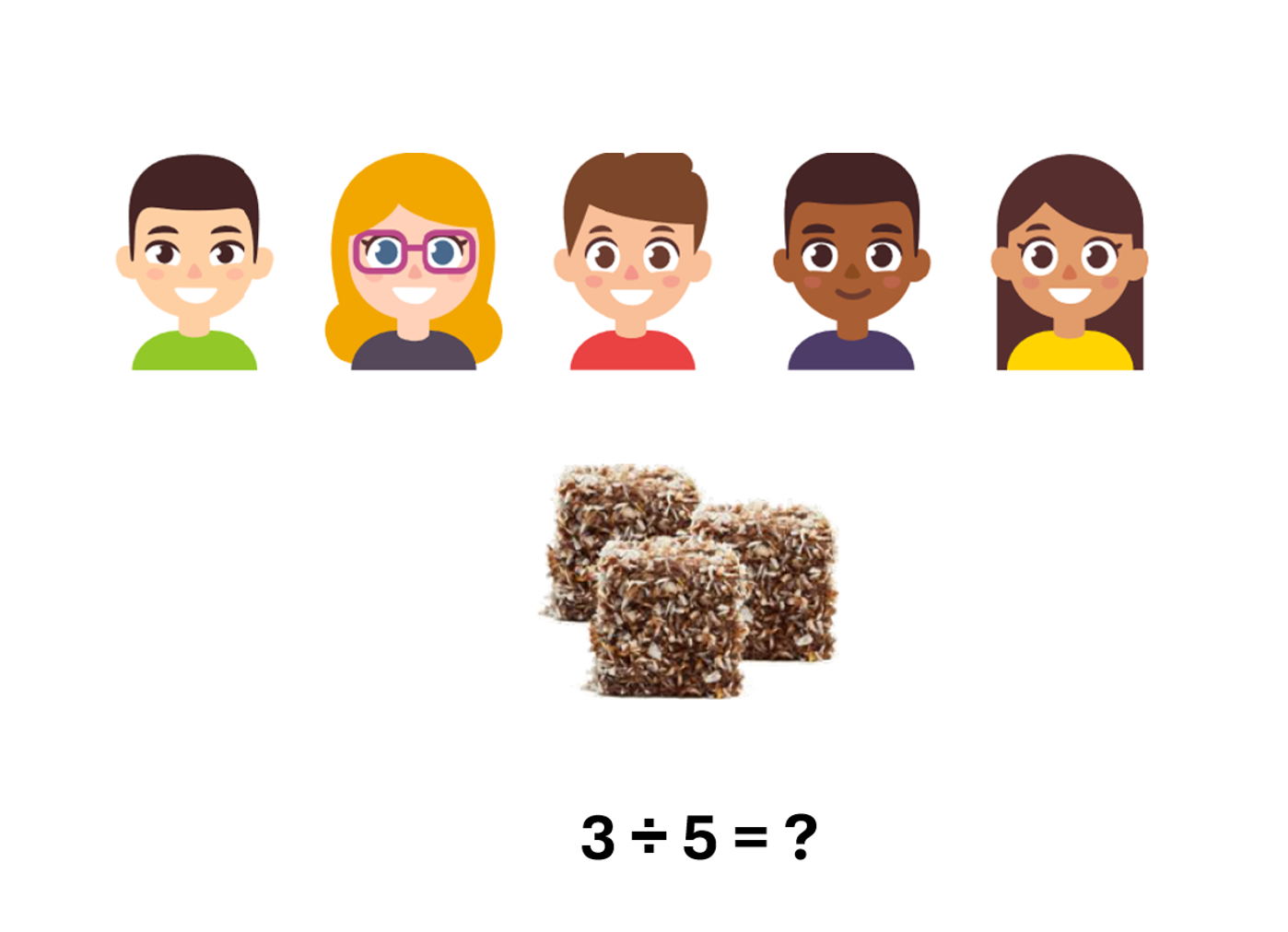
Equivalence can be difficult for students to conceptualise because any fraction can be written in infinite ways.
Equivalent fractions are fractions that look different but represent the same value or amount. They show the same proportional relationship as the ratio between the numerator and denominator stays the same, even though the numbers change.
For example:
$$\frac{1}{2}=\frac{2}{4}=\frac{4}{8}$$
All of these fractions represent the same proportion (1:2).
Likewise, fractions can be divided into unit fractions which are equivalent to the original fraction. For example, to answer the question: What fraction does each student get when two lamingtons are divided between three students?
Using the strategy of dividing each lamington up into the same number of parts as students, we could say:
$$2 \div 3 = \frac{2}{3}$$
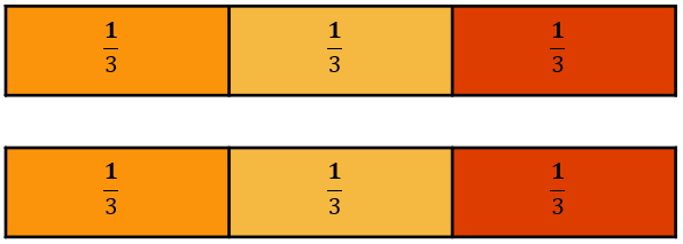
Using the strategy of dividing lamingtons into unit fractions, we could say:
$$2 \div 3 = \frac{1}{2} + \frac{1}{6}$$
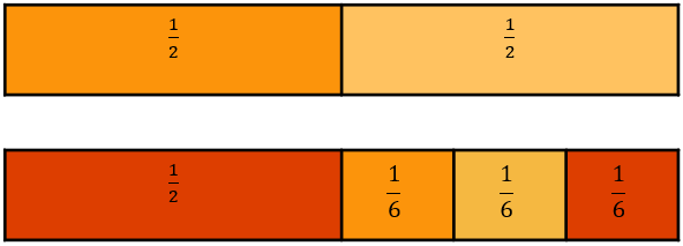
Indeed, any fraction is the sum of unit fractions.
Equivalence can be difficult for students to conceptualise because any fraction can be written in infinite ways.
Equivalent fractions are fractions that look different but represent the same value or amount. They show the same proportional relationship as the ratio between the numerator and denominator stays the same, even though the numbers change.
For example:
$$\frac{1}{2}=\frac{2}{4}=\frac{4}{8}$$
All of these fractions represent the same proportion (1:2).
Likewise, fractions can be divided into unit fractions which are equivalent to the original fraction. For example, to answer the question: What fraction does each student get when two lamingtons are divided between three students?
Using the strategy of dividing each lamington up into the same number of parts as students, we could say:
$$2 \div 3 = \frac{2}{3}$$
Using the strategy of dividing lamingtons into unit fractions, we could say:
$$2 \div 3 = \frac{1}{2} + \frac{1}{6}$$
Indeed, any fraction is the sum of unit fractions.