

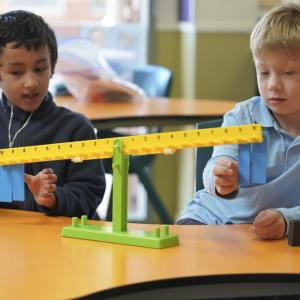
'Algebra: Balancing act' is a reimagining of classic V8 sequence 'Algebra: Equivalence'
- On the 'In this sequence' tab you'll find all the lessons in this sequence, a suggested implementation plan and curriculum alignment.
- The 'Behind this sequence' tab shows how key mathematical ideas develop over the sequence.
- Have you taught this sequence? Use the Feedback button to let us know how it went!
Lessons in this sequence

Task 1 • Balancing numbers
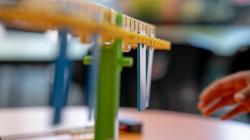
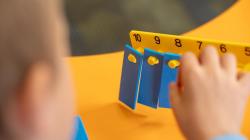
Students balance two numbers on either side of the number balance. They record their solutions as equations, using the equals sign as a symbol for balance.

Task 2 • Card balance
Students play a card game where the aim is to balance sets of numbers.
Task 3 • Balancing blocks
Students compare pictures of differently weighted blocks balanced on scales. They use these pictures as a reference to decide whether additional pictures of blocks will balance.

Task 4 • Finding equivalence
Students express their understanding of equivalence as balance using different contexts.
Suggested implementation
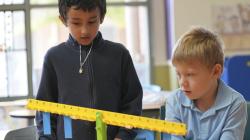
This sequence has been designed for Year 2 students and assumes some prior understanding of the concepts of partitioning, re-grouping and number combinations. We recommend implementing this teaching sequence over four consecutive days, with the lesson timings provided in the documentation designed to support this approach.
This sequence aligns with the Australian Curriculum: Mathematics Year 2 content descriptors and achievement standard, and it uses balance as a model to support students to reason about the equals sign and equivalence.
The Australian Academy of Science supports and encourages broad use of its material. Unless indicated below, copyright material available on this website is licensed under a Creative Commons Attribution-NonCommercial-ShareAlike 4.0 International (CC BY-NC-SA 4.0) licence.
Curriculum and syllabus alignment
Year 2
By the end of Year 2, students use mathematical modelling to solve practical additive problems representing the situation and choosing the calculation strategy. They describe and continue patterns that increase and decrease additively identify missing elements in a pattern. Students recall and develop proficiency with addition and subtraction facts within 20.
Number
Add and subtract one- and two-digit numbers, representing problems using number sentences and solve using part-part-whole reasoning and a variety of calculation strategies
Algebra
Recall and demonstrate proficiency with addition facts to 20; extend and apply facts to develop related subtraction facts
Recognise, describe and create additive patterns that increase or decrease by a constant amount, using numbers, shapes and objects, and identify missing elements in the pattern
Each task in this sequence uses the Launch-Explore-Connect-Summarise task structure.
Equivalence is a central idea in algebra, and the equals sign asserts that two expressions have the same value. Students are first introduced to the equals sign in early mathematics when they use it to indicate the result of a calculation. In these contexts, it is commonly interpreted as signaling that “the answer comes next”. However, as Darr (2003) emphasises, the equals sign is not simply an instruction to compute; rather, it expresses a meaningful relationship between two quantities. Understanding the equals sign as a symbol of equivalence, rather than a procedural cue, is essential for the development of algebraic reasoning.
This learning sequence is designed to confront and extend students’ existing conceptions of the equals sign and equivalence. Through carefully structured tasks, students are encouraged to rethink the meaning of the equals sign as representing balance and equality, rather than simply signalling an answer. They are supported to construct and represent equivalent expressions, using both symbolic notation and visual models (such as number balance and pan balance representations). In doing so, students begin to develop a more flexible and relational understanding of mathematical equality, which is essential for success in algebra.
| Learning goals | Students’ mathematical activity | Representation | Context | |
| Task 1 | The equals sign means “is the same as”. The equals sign means “balance”. | Students place two weights onto number hooks, on one side of a number balance, and two weights onto different number hooks, on the other side, to make them balance. They record their solutions as equations, using the equals sign as a symbol denoting balance. | Students place weights on a number balance to explore equivalence in a concrete way. A number balance illustrates how to maintain equivalence when the weights on one side of the balance are moved to different numbers on the same side. | Number balance is used to show how different weights can balance when they are placed on numbers which add up to an equivalent amount. A number line shows how as one number increases by 1, another needs to decrease by 1 to maintain the balance. |
| Task 2 | The equals sign shows that the expressions on both sides of an equation have the same value. | Students make number combinations which are equivalent. | Students generate sets of numbers using playing cards to try to create equivalent totals. | A card game provides a context for exploring equivalent number set combinations. |
| Task 3 | Equivalence means balance. | Students compare different weight blocks which balance. They use this information to decide whether different combinations of these blocks still balance. | Students compare visual model of balance pans and weights. | Equivalent sets of weights on balance pans provide clues for different combinations of weights which may or may not balance. |
| Task 4 | The equals sign shows that the expressions on both sides of an equation have the same value. Equivalence means balance. | Students balance number weights, write number sentences, using the equals sign to express equivalent values, and draw different combinations of blocks to balance a scale. | Students experience and represent equivalence as balance in a variety of ways. | Making quantities and blocks balance provides tangible ways to consider equivalence. |
References
Darr, C. (2003). The meaning of “equals”. New Zealand Council for Education Research, 2(4), 7.

'Algebra: Balancing act' is a reimagining of classic V8 sequence 'Algebra: Equivalence'
- On the 'In this sequence' tab you'll find all the lessons in this sequence, a suggested implementation plan and curriculum alignment.
- The 'Behind this sequence' tab shows how key mathematical ideas develop over the sequence.
- Have you taught this sequence? Use the Feedback button to let us know how it went!