

Algebra: Balancing act
View Sequence overviewThe equals sign shows that the expressions on both sides of an equation have the same value.
Equivalence means balance.
Whole class
Balancing act Slides
Each student
Finding equivalence Student sheet
Build
Revise: We have explored how numbers or blocks that look different may balance because they are equivalent. We use the equals sign to show that the amount on one side is equivalent to the amount on the other side. The equals sign means “the same as”.
Invite students to discuss what they understand about equivalence and how the number balance and balancing the blocks connect with this.
Show students Slide 24 of Balancing act Slides.
Click on the slide title for the link to the virtual number balance.
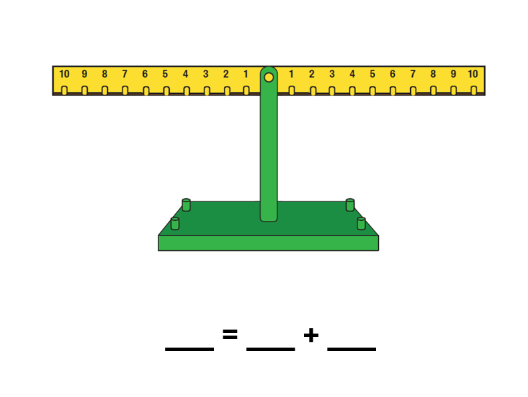
Discuss how to balance the number balance using one weight on one side and two weights on the other side.
Invite student suggestions for numbers and how to record this information using an equals sign. For example, 8 = 3 + 5.
Ask students to share other examples of equivalence that they know.
Pose the activity: You are going to use what you have learnt to solve some problems about equivalence and balance.
Provide each student with the Finding equivalence Student sheet, which includes additional practice equations and scales for students to balance.
Explain that they will work on their own to complete this task. Allow students time to complete the task independently.
When they have finished, discuss what they understand about equivalence and using the equals sign.
Ask: How would you explain using the equals sign to a student in a lower year group? What might you use to help you explain this?
Conclude this lesson with students sharing some of their own examples of equivalence from the task.
Indicators of student understanding
Here are some examples of what students might do and what it indicates about their understanding.
Limited understanding of equivalence
- Treats equals sign as “answer comes next”
- Counts sides separately but doesn’t compare totals
- Needs prompting to balance
Beginning to understand equality as balance
- Knows both sides must be the same
- Solves simple missing number problems (e.g. 5 = 3 + ?)
- Explains thinking in basic terms (“needs more”)
Clear understanding of equivalence
- Recognises equals sign means “the same as”
- Explains thinking using “same”, “equal”, “balance”
- Consistently balances both sides accurately
- Uses number facts rather than counting all
- Creates equivalent expressions (e.g. 6 + 4 = 5 + 3 + 2)
- Solves missing number problems (e.g. 20 + ? = 14 + 10)
- Explains reasoning clearly (“both sides are 12”)
Generalises and reasons flexibly
- Creates their own equivalent equations
- Uses efficient strategies (compensation, known facts)
- Justifies multiple solutions
- Predicts outcomes before acting
Here are some examples of what students might do and what it indicates about their understanding.
Limited understanding of equivalence
- Treats equals sign as “answer comes next”
- Counts sides separately but doesn’t compare totals
- Needs prompting to balance
Beginning to understand equality as balance
- Knows both sides must be the same
- Solves simple missing number problems (e.g. 5 = 3 + ?)
- Explains thinking in basic terms (“needs more”)
Clear understanding of equivalence
- Recognises equals sign means “the same as”
- Explains thinking using “same”, “equal”, “balance”
- Consistently balances both sides accurately
- Uses number facts rather than counting all
- Creates equivalent expressions (e.g. 6 + 4 = 5 + 3 + 2)
- Solves missing number problems (e.g. 20 + ? = 14 + 10)
- Explains reasoning clearly (“both sides are 12”)
Generalises and reasons flexibly
- Creates their own equivalent equations
- Uses efficient strategies (compensation, known facts)
- Justifies multiple solutions
- Predicts outcomes before acting
Physical versus virtual number balances
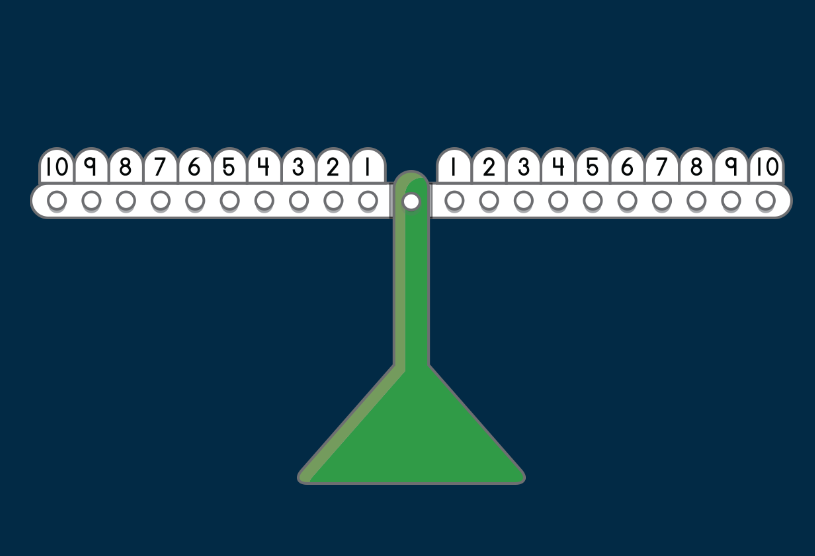
In Task 1, we strongly recommended using a physical number balance, but here a virtual number balance is appropriate.
The purpose of using the virtual number balance here, rather than a physical model, is to encourage students to connect the concrete activity of Task 1 with its pictorial/virtual representation. In this task, students represent their understanding of equivalence using numerals and drawings, so the use of the virtual number balance reflects this.
Nevertheless, use your professional judgement where you have students who would benefit from using the physical balance to express their understanding. This task may serve as a record of individual student understanding at the end of the sequence.
In Task 1, we strongly recommended using a physical number balance, but here a virtual number balance is appropriate.
The purpose of using the virtual number balance here, rather than a physical model, is to encourage students to connect the concrete activity of Task 1 with its pictorial/virtual representation. In this task, students represent their understanding of equivalence using numerals and drawings, so the use of the virtual number balance reflects this.
Nevertheless, use your professional judgement where you have students who would benefit from using the physical balance to express their understanding. This task may serve as a record of individual student understanding at the end of the sequence.