

Algebra: Balancing act
View Sequence overviewEquivalence means balance.
Whole class
Balancing act Slides
Each student
Balancing blocks Student sheet
Task
Revise: In the previous task, we explored how the numbers on one side of the equals sign are worth the same as the numbers on the other side. They might look different, but they balance because they are worth the same.
Show students Slide 18 of the Balancing act Slides and explain that each of these blocks has a different weight.
Show Slide 19. The blocks shown balance each other. Click the slide so that students can see the first unbalanced scale and question.
Ask: How many green balls could weigh more than the blue cube?
Invite students to justify their reasoning. Repeat for the second unbalanced scale and question.
Ask: How many green balls could weigh less than the blue cube?
Show Slide 20. The blocks shown balance each other. Click the slide so that students can see the first unbalanced scale and question.
Ask: How many orange cylinders could weigh more than the blue cube?
Invite students to justify their reasoning. Repeat for the second unbalanced scale and question.
Ask: How many orange cylinders could weigh less than the blue cube?
Show Slide 21. Discuss what students can deduce from these scales. Click the slide so that students can see the question.
Ask: How many green balls balance how many orange cylinders?
Invite students to justify their reasoning.
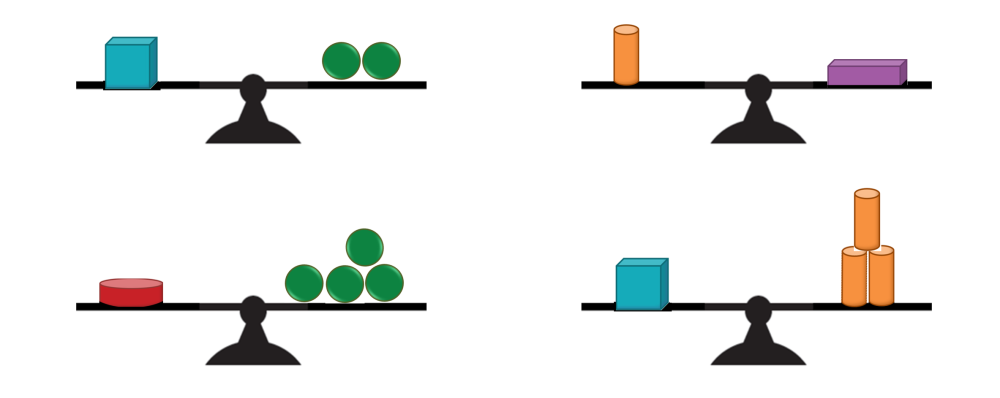
Show Slide 22. Discuss and compare the balanced blocks in this slide, but avoid using numbers or assigning values to any of the blocks.
- Which blocks might be heavier? Which might be lighter?
- Which equivalent combinations of blocks are easy to see?
- How might you use this information to help balance the scales?
Explain that they will be shown some more pictures of blocks on scales, and they will use this information to decide which blocks balance each other, and which do not.
Pose the task: Use the picture of the balanced scales to help you find the combinations of blocks which balance. Draw in extra blocks to balance scales which don’t balance.
Equivalence without numbers
Balance scale activities are a powerful way to develop students’ number sense and early algebraic reasoning. While this task uses images of balance scales, you may choose to begin with a physical balance scale so that students can experience the concept of balance firsthand. The pictures can then be used to consolidate and extend their thinking.
It is important to recognise that balance scales can be used to represent both equality and inequality. When a set of blocks on one side of the scale balances a set of blocks on the other side, students can see a representation of equal weight. In contrast, when students are challenged to make the scale unbalanced using the same set of blocks, they discover that there are many possible ways to create inequality.
As students engage with the task, they compare different combinations of blocks that balance the scale. At this stage, it is important not to assign numerical values to the blocks, as doing so encourages students to focus on calculation, whereas leaving the blocks without assigned values promotes logical and deductive reasoning. Without numbers, students shift their attention from "working it out" to noticing, describing, and justifying relationships between the quantities represented.
As students examine different balanced combinations, they begin to recognise that equivalent relationships can exist even when the collections of blocks appear quite different. Through discussion and reasoning, they discover that certain groups of blocks can be exchanged for others while maintaining balance.
This task supports the development of students' understanding of equivalence: the idea that the same quantity can be represented in different ways. Equivalence is a foundational mathematical concept underpinning equality and later algebraic thinking. Developing a strong conceptual understanding of equivalence helps students move beyond counting and computation to reason about unknown quantities, relationships, and mathematical structures. This understanding provides an important foundation for future success in algebra.
Balance scale activities are a powerful way to develop students’ number sense and early algebraic reasoning. While this task uses images of balance scales, you may choose to begin with a physical balance scale so that students can experience the concept of balance firsthand. The pictures can then be used to consolidate and extend their thinking.
It is important to recognise that balance scales can be used to represent both equality and inequality. When a set of blocks on one side of the scale balances a set of blocks on the other side, students can see a representation of equal weight. In contrast, when students are challenged to make the scale unbalanced using the same set of blocks, they discover that there are many possible ways to create inequality.
As students engage with the task, they compare different combinations of blocks that balance the scale. At this stage, it is important not to assign numerical values to the blocks, as doing so encourages students to focus on calculation, whereas leaving the blocks without assigned values promotes logical and deductive reasoning. Without numbers, students shift their attention from "working it out" to noticing, describing, and justifying relationships between the quantities represented.
As students examine different balanced combinations, they begin to recognise that equivalent relationships can exist even when the collections of blocks appear quite different. Through discussion and reasoning, they discover that certain groups of blocks can be exchanged for others while maintaining balance.
This task supports the development of students' understanding of equivalence: the idea that the same quantity can be represented in different ways. Equivalence is a foundational mathematical concept underpinning equality and later algebraic thinking. Developing a strong conceptual understanding of equivalence helps students move beyond counting and computation to reason about unknown quantities, relationships, and mathematical structures. This understanding provides an important foundation for future success in algebra.
Students work in small groups. Provide each student with the Balancing blocks Student Sheet.
Allow the students time to discuss which of the pictures of the blocks balance and which do not, and to add in any additional blocks to those that do not balance.
Use a Spotlight here to highlight student work which demonstrates combinations of blocks that are equivalent in weight and balance each other. Encourage students to use what they already know about relationships between the blocks to determine the values or combinations they do not yet know, reinforcing the idea that equivalent expressions represent the same quantity.
Examples of students’ mathematical thinking might include:
- comparing relationships between different blocks. For example:
- one blue cube equals two green spheres, and it is also the same as three orange cylinders. So, two green spheres are the same as three orange cylinders.
- taking the same value from each side for it to balance. For example:
- one blue square equals two green spheres, so one blue cube and one green sphere do not equal two blue cubes.
Allow students to make any changes they choose to their work following the Spotlight.
Select a few students to share their strategies during the Connect phase.
Spotlight
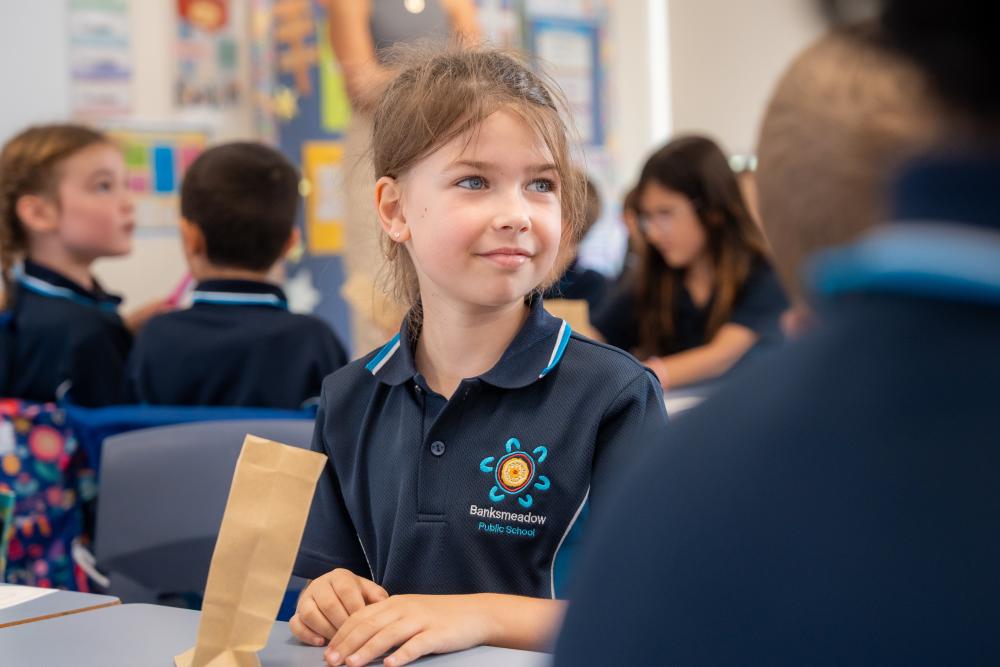
A Spotlight is used here as an opportunity for the whole class to pause and for you to actively guide and support student learning. The teacher asks students probing questions to help explain their thinking and justify the strategies they used to decide which pictures are balanced and what to add to make them balance.
The teacher might ask:
- What thinking did you use to get started?
- What did you already know which helped you begin?
- Explain why you chose this combination of blocks?
- How do you know for certain that these blocks will balance?
- Why don’t these blocks balance?
- Did anyone use a different combination?
The Spotlight offers opportunity for students to see the work of others in the class. It invites questions, prompts discussion, deepens understanding, and encourages them to reflect on their own work and that of other students. It facilitates them to construct their own meaning through their experiences and mathematical discourse.
A Spotlight is used here as an opportunity for the whole class to pause and for you to actively guide and support student learning. The teacher asks students probing questions to help explain their thinking and justify the strategies they used to decide which pictures are balanced and what to add to make them balance.
The teacher might ask:
- What thinking did you use to get started?
- What did you already know which helped you begin?
- Explain why you chose this combination of blocks?
- How do you know for certain that these blocks will balance?
- Why don’t these blocks balance?
- Did anyone use a different combination?
The Spotlight offers opportunity for students to see the work of others in the class. It invites questions, prompts discussion, deepens understanding, and encourages them to reflect on their own work and that of other students. It facilitates them to construct their own meaning through their experiences and mathematical discourse.
The purpose of this Connect phase is for students to have a chance to:
|
Invite selected students to share their reasoning about which combinations of blocks balance and which do not. Encourage students to justify their reasoning using the relationships they notice between blocks that balance.
Some examples of student reasoning might include:
- comparing relationships between different blocks. For example:
- one blue cube equals two green spheres, and it is also the same as three orange cylinders. So, two green spheres are the same as three orange cylinders.
- one red flat cylinder equals four green spheres, and one blue cube equals two green spheres. So, one flat red cylinder equals two blue cubes.
- taking the same value from each side for it to balance. For example:
- one blue cube equals two green spheres, so one blue cube and one green sphere do not equal two blue cubes.
- reasoning that It doesn’t matter on which side of the scale the blocks are as long as the weight is the same.
Revisit Slide 22 of the Balancing act Slides.
Invite students to justify their reasoning using the relationships they notice between blocks that balance.
Explain: When different combinations of blocks balance this means that they are equivalent. When they do not balance this means that they are not equivalent.