

Algebra: Balancing act
View Sequence overviewThe equals sign shows that the expressions on both sides of an equation have the same value.
Whole class
Balancing act Slides
Card Balance teacher notes
Equals sign cards class sheet
Each group
Deck of playing cards
Each student
1 equals sign (from Equals sign cards class sheet)
Build
Revise: In the previous task, we explored how the equals sign shows that the numbers on one side of it are worth the same as the numbers on the other side. They might look different, but they balance because they have the same total value.
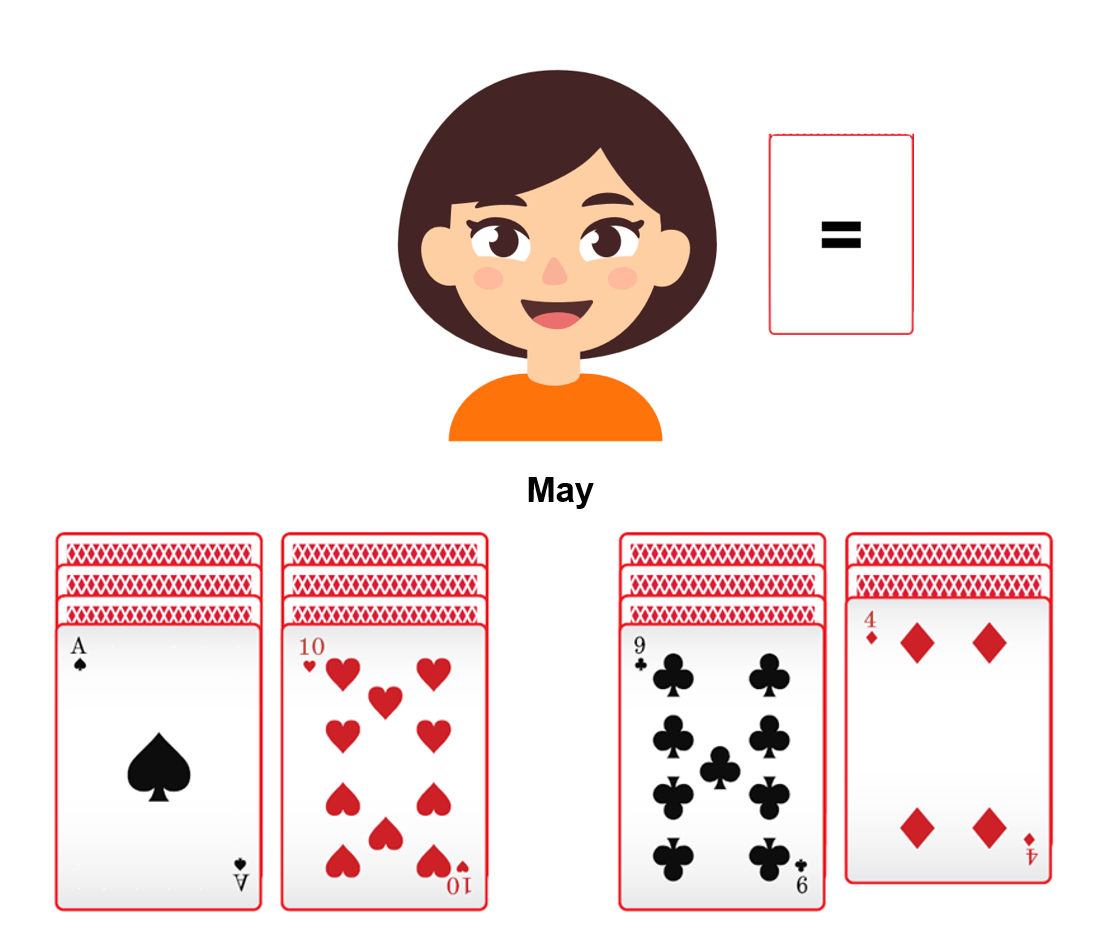
With students, use Slides 9-15 of Balancing act Slides to guide learning how to play the game Card Balance. You may refer to the Card Balance teacher notes as they describe the player moves (in the slides) in greater detail.
Setup
Each group needs:
- 2-3 players
- 1 deck of cards
Each player is given:
- four piles of four cards, placed face down, in two sets of two.
- an equals sign card.
How to play
- All players flip over the top card on each of their four card piles.
- Players take turns to discard one of their top cards and flip over the card underneath. Each discarded card is out of play.
- If a player’s sets of number cards balance, they put the equals sign in the gap between the sets and their score is zero.
- The number cards = the number value
- An ace = 1
- A picture card (King, Queen or Jack) = 0
- The game ends when all players have balanced their cards or have no more cards left to flip over.
- At the end of the game, a player’s score is the difference between their two pairs of cards.
- The lowest score over three games wins.
As you model the game in the slides, invite students to work out the totals of the cards on each slide, to see if they are equivalent and balance.
Playing cards and mathematics
In this task, students explore the concept of equivalence using playing cards that represent quantities in two ways: as visual patterns that can be subitised and as numerals. The game provides a relaxed, engaging context for learning; however, its value lies not simply in playing the game, but in supporting students to develop meaningful mathematical understanding (Swan & Hurrell, 2012).
To maximise the learning potential of the activity, teachers need to make explicit connections between the actions students take during the game and the underlying mathematical concepts being developed. Throughout the game, each student combines the values of their two sets of cards and compare them to see if they make the same total. They use an equals card to represent when two totals have the same value. This creates opportunities to reinforce the meaning of the equals sign as 'the same as' rather than simply an instruction to calculate an answer.
This understanding builds on Task 1, where students used a number balance to represent equality. In that context, the equals sign indicated that two quantities balanced because they had the same value. Using the equals sign within the card game maintains this focus on equivalence while introducing a different representation. In doing so, students broaden their understanding of the interconnected concepts of balance, sameness, and equality across different mathematical contexts.
Swan and Hurrell (2012) argue that effective mathematical games engage students in developing meaningful mathematical understanding through the act of playing. This game encourages students to draw on their part-part-whole knowledge as they mentally combine the values of two cards and determine whether their total is equivalent to another. Through repeated play, students have opportunities to strengthen number sense, develop fluency with number combinations, and deepen their understanding of equivalence.
The game is accessible for young learners because it has simple rules, requires minimal preparation, and can be played efficiently once students are familiar with the format. It also creates opportunities for mathematical discussion, reasoning, and justification as students explain how they know two totals are equal. Furthermore, the game can be readily adapted to provide additional support or challenge, making it responsive to the diverse learning needs of students within the classroom (Swan & Hurrell, 2012).
Differentiation
This game can be adapted to make it more or less challenging for students (Bragg 2006). Some ways to do this might be:
- reducing the challenge by:
- comparing one card with two cards.
- limiting the number of cards to smaller values so that students can use subitising to calculate in their heads.
- increasing the challenge by:
- comparing two cards with three cards, or three cards with three cards.
- giving the picture cards ascending values (J = 11, Q = 12, K = 13).
Furthermore, students can be a great source of ideas for other ways to do this, after they have played a few times.
References
Bragg, Leicha 2006, Students` impressions of the value of games for the learning of
mathematics, in Proceedings of the 30th conference of the international group for the
psychology of mathematics education, International Group for the Psychology of
Mathematics Education, Cape Town, South Africa, pp. 217-224. http://hdl.handle.net/10536/DRO/DU:30005948
Swan, P., & Hurrell, D. (2012). Mathematical games: Just trivial pursuits? Prime Number, 27(1), 3-5.
In this task, students explore the concept of equivalence using playing cards that represent quantities in two ways: as visual patterns that can be subitised and as numerals. The game provides a relaxed, engaging context for learning; however, its value lies not simply in playing the game, but in supporting students to develop meaningful mathematical understanding (Swan & Hurrell, 2012).
To maximise the learning potential of the activity, teachers need to make explicit connections between the actions students take during the game and the underlying mathematical concepts being developed. Throughout the game, each student combines the values of their two sets of cards and compare them to see if they make the same total. They use an equals card to represent when two totals have the same value. This creates opportunities to reinforce the meaning of the equals sign as 'the same as' rather than simply an instruction to calculate an answer.
This understanding builds on Task 1, where students used a number balance to represent equality. In that context, the equals sign indicated that two quantities balanced because they had the same value. Using the equals sign within the card game maintains this focus on equivalence while introducing a different representation. In doing so, students broaden their understanding of the interconnected concepts of balance, sameness, and equality across different mathematical contexts.
Swan and Hurrell (2012) argue that effective mathematical games engage students in developing meaningful mathematical understanding through the act of playing. This game encourages students to draw on their part-part-whole knowledge as they mentally combine the values of two cards and determine whether their total is equivalent to another. Through repeated play, students have opportunities to strengthen number sense, develop fluency with number combinations, and deepen their understanding of equivalence.
The game is accessible for young learners because it has simple rules, requires minimal preparation, and can be played efficiently once students are familiar with the format. It also creates opportunities for mathematical discussion, reasoning, and justification as students explain how they know two totals are equal. Furthermore, the game can be readily adapted to provide additional support or challenge, making it responsive to the diverse learning needs of students within the classroom (Swan & Hurrell, 2012).
Differentiation
This game can be adapted to make it more or less challenging for students (Bragg 2006). Some ways to do this might be:
- reducing the challenge by:
- comparing one card with two cards.
- limiting the number of cards to smaller values so that students can use subitising to calculate in their heads.
- increasing the challenge by:
- comparing two cards with three cards, or three cards with three cards.
- giving the picture cards ascending values (J = 11, Q = 12, K = 13).
Furthermore, students can be a great source of ideas for other ways to do this, after they have played a few times.
References
Bragg, Leicha 2006, Students` impressions of the value of games for the learning of
mathematics, in Proceedings of the 30th conference of the international group for the
psychology of mathematics education, International Group for the Psychology of
Mathematics Education, Cape Town, South Africa, pp. 217-224. http://hdl.handle.net/10536/DRO/DU:30005948
Swan, P., & Hurrell, D. (2012). Mathematical games: Just trivial pursuits? Prime Number, 27(1), 3-5.
Organise students into small groups. Provide each group of students with a deck of playing cards and provide each student with an Equals sign card.
Show Slide 16 of the Balancing act Slides to remind students how to play Card Balance.
Pose the activity: Play Card Balance to find card combinations with equivalent values.
Allow students time to play three games or so. Listen to their reasoning as they play, so that you can discuss some of their ideas in Task 3.
Observation
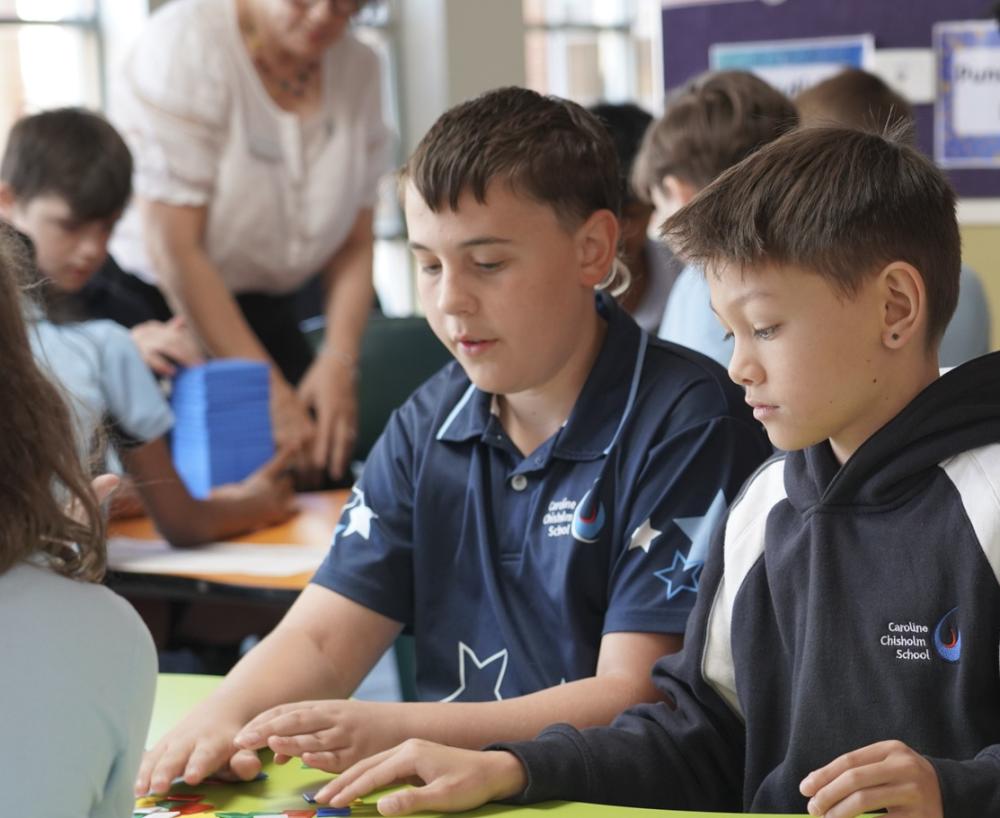
During this game, the focus of teacher noticing is to carefully attend to and make sense of what students say and do, in relation to both the mathematics and what the teacher knows about each learner.
To do this well, the teacher needs a clear understanding of the reasoning and strategies students are likely to use as they explore the concept of equivalence, as well as clear criteria for the key mathematical ideas students are expected to develop.
To intentionally observe and interpret student understanding, it is helpful to anticipate what this understanding might look like and sound like in practice, and to use this to guide your observations during the game.
By Year 2, students are already building a range of reasoning and calculation strategies that can support their understanding of equivalence and balance, and this task provides an opportunity to notice and extend these.
Some examples of criteria of student reasoning and strategies you notice being used might include:
- using part-part-whole thinking to calculate.
- subtracting or counting on to find the difference between the two quantities.
- reasoning about which card to discard or keep.
- predicting the number they need to flip over to balance the other side.
- reasoning about continuing to play or stop, based on score.
- describing why/how the two cards are equivalent when they find a balance.
- using the language of more, less, equal, equivalent, balance etc.
You can include some of these, as well as other relevant criteria that arise from your own observations, as part of your ongoing formative assessment of your students’ understanding.
During this game, the focus of teacher noticing is to carefully attend to and make sense of what students say and do, in relation to both the mathematics and what the teacher knows about each learner.
To do this well, the teacher needs a clear understanding of the reasoning and strategies students are likely to use as they explore the concept of equivalence, as well as clear criteria for the key mathematical ideas students are expected to develop.
To intentionally observe and interpret student understanding, it is helpful to anticipate what this understanding might look like and sound like in practice, and to use this to guide your observations during the game.
By Year 2, students are already building a range of reasoning and calculation strategies that can support their understanding of equivalence and balance, and this task provides an opportunity to notice and extend these.
Some examples of criteria of student reasoning and strategies you notice being used might include:
- using part-part-whole thinking to calculate.
- subtracting or counting on to find the difference between the two quantities.
- reasoning about which card to discard or keep.
- predicting the number they need to flip over to balance the other side.
- reasoning about continuing to play or stop, based on score.
- describing why/how the two cards are equivalent when they find a balance.
- using the language of more, less, equal, equivalent, balance etc.
You can include some of these, as well as other relevant criteria that arise from your own observations, as part of your ongoing formative assessment of your students’ understanding.