

Algebra: Balancing act
View Sequence overviewThe equals sign means “is the same as”.
The equals sign means “balance”.
Whole class
Number balance and weights (physical number balance strongly recommended, but a virtual math balance can be used if a physical number balance is unavailable)
Equals sign drawn on a card
Balancing act Slides
Each group
Number balance and weights
A4 paper to record equations
Task
Show students a physical number balance and discuss what it is.
Discuss:
- what they notice about it (e.g. It has numbers and pegs, it is like a see-saw.)
- how it could be used.
- what maths they could explore using it.
Place an equals sign on the fulcrum of the number balance and discuss what it means. Student suggestions might include:
- makes
- the answer is
- is the same as
Ask students for some numbers that balance, for example:
- Four balances with two and two.
- Three and one balances with four.
- Three and one balances with two and two.
Record each balanced set of numbers as an equation, such as:
- 4 = 2 + 2
- 3 + 1 = 4
- 3 + 1= 2 + 2
Pose the task: I put two weights on one side of the balance, and I put two weights on the other side. The number balance is balanced. What numbers might I have put the weights on? How many combinations can you find?
Why use the equals sign?
Students often read the equals sign as a prompt to calculate and find an answer, as they often first come into contact with it through experiences of computation and learning basic number facts. However, it is crucial, even from the Foundation years, that students develop an understanding of the equals sign as a symbol which represents a relationship rather than simply as a signal to compute. Establishing this conceptual foundation helps prevent common misconceptions and supports a deeper understanding of equality. Without this, students may not readily recognise that both sides of an equation can be equivalent even when they consist of different numbers—a misunderstanding that can persist into secondary school.
In this task, a number balance is used to demonstrate combinations of numbers where there is no single “answer side”. As students seek combinations that balance, they begin to see the relationship between the numbers on either side, and are pushed to think about what the equals sign actually means.
The equations used in this task have expressions on both sides, which disrupts this pattern. There is no single “answer side”, so students are pushed to think about what the equals sign actually means. When they see combinations like 3 + 1 = 2 + 2, they begin to understand that the equals sign shows the totals on both sides are the same.
A tangible way to reinforce this concept is to place an equals sign at the fulcrum of the number balance; when both sides have the same total, the balance is level, mirroring the horizontal lines of the equals sign.
Students come “…to recognise the equals sign as a symbol that represents equivalence and balance” (Mann, 2004, p. 65).
References
Mann, R. L. (2004). Balancing act: The truth behind the equals sign. Teaching Children Mathematics, 11(2), 65-69.
Students often read the equals sign as a prompt to calculate and find an answer, as they often first come into contact with it through experiences of computation and learning basic number facts. However, it is crucial, even from the Foundation years, that students develop an understanding of the equals sign as a symbol which represents a relationship rather than simply as a signal to compute. Establishing this conceptual foundation helps prevent common misconceptions and supports a deeper understanding of equality. Without this, students may not readily recognise that both sides of an equation can be equivalent even when they consist of different numbers—a misunderstanding that can persist into secondary school.
In this task, a number balance is used to demonstrate combinations of numbers where there is no single “answer side”. As students seek combinations that balance, they begin to see the relationship between the numbers on either side, and are pushed to think about what the equals sign actually means.
The equations used in this task have expressions on both sides, which disrupts this pattern. There is no single “answer side”, so students are pushed to think about what the equals sign actually means. When they see combinations like 3 + 1 = 2 + 2, they begin to understand that the equals sign shows the totals on both sides are the same.
A tangible way to reinforce this concept is to place an equals sign at the fulcrum of the number balance; when both sides have the same total, the balance is level, mirroring the horizontal lines of the equals sign.
Students come “…to recognise the equals sign as a symbol that represents equivalence and balance” (Mann, 2004, p. 65).
References
Mann, R. L. (2004). Balancing act: The truth behind the equals sign. Teaching Children Mathematics, 11(2), 65-69.
Students work in small groups. Provide each group with a physical number balance (or if they do not have access to a physical number balance, they may use a virtual math balance) and A4 paper to record numbers that balance as equations, using the equals sign.
Allow students time to find numbers that balance and to record these as equations.
- What other numbers do you predict might balance these two weights?
- What strategies have you used to help find numbers that balance?
- Have you found all the possible ways to balance two weights on one side by placing two weights on the other side?
Some limited understandings may include:
- treating the equals sign as “find the answer” rather than “balances”.
- only using the same numbers to balance weights on both sides. For example, 3 + 4 = 3 + 4, 2 + 1 = 2 + 1.
- counting every time instead of using relationships between numbers. For example, adding 3 + 2 and then adding 4 + 1, but not noticing that 4 is 1 more than 3 and 1 is 1 less than 2 so these balance too.
After students have found some ways to balance the numbers, pause the class to conduct a Checkpoint. Focus on examples of student work to help students to understand that the equals sign means both sides of the number balance are balanced.
Following this, allow students time to revisit and revise their own work based on what they’ve seen or heard.
Select examples of student strategies to discuss during the Connect phase.
Checkpoint
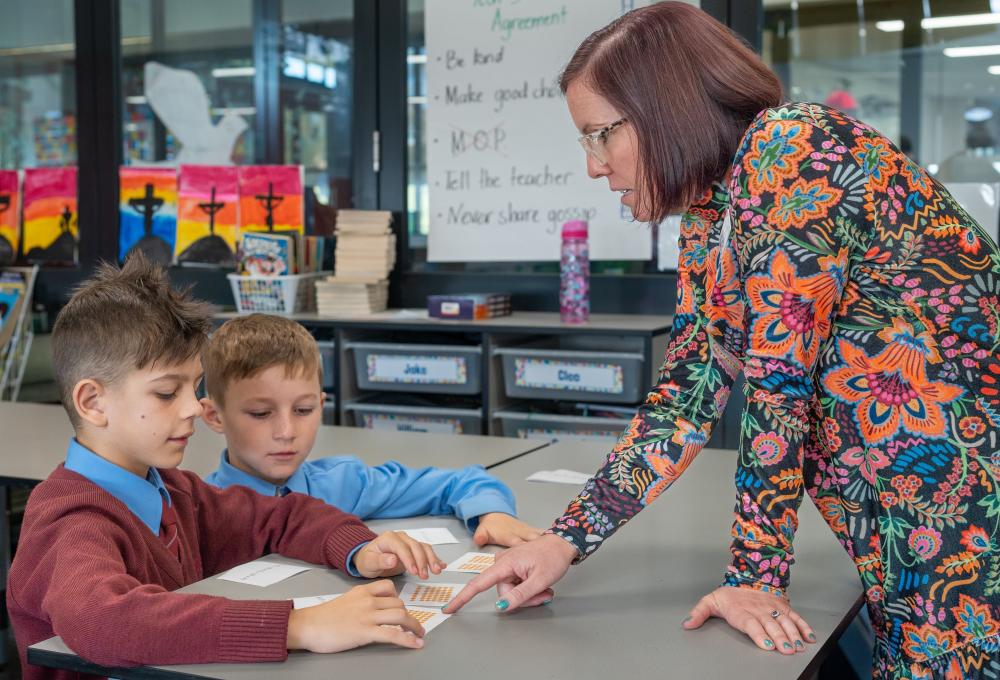
A Checkpoint is a brief pause in learning where the teacher draws the class’s attention to examples of student thinking that can help everyone learn. The teacher shows examples of student work which illustrate the mathematics they want students to understand as they develop their understanding of the meaning of the equals sign.
Look for examples of student work that show:
- relational reasoning about how the sides relate to each other, not just what the totals are.
- generalising equivalence rules such as if I increase one number by 1, I must decrease the other number by 1 so they are equivalent in value.
- predicting outcomes before adjusting the balance.
- using structure such as recognising patterns like doubles, near-doubles, or fact families.
- decomposition by breaking numbers into parts to make balancing easier.
The teacher also chooses examples which reflect some of the challenges that students might experience. Drawing student attention to these also provides opportunities to discuss what has not been fully understood. This is valuable as students can compare this with their own work to see if they understand. Examples may include:
- treating the equals sign as “find the answer” rather than “same as”.
- only using the same numbers to balance weights on both sides. For example, 3 + 4 = 3 + 4; 2 + 1 = 2 + 1 (although this is an opportunity to model the commutative property).
- counting every time instead of using relationships between numbers. For example, adding 3 + 2 and then adding 4 + 1, but not noticing that four is one more than three and one is one less than two, so these balance.
A Checkpoint is a brief pause in learning where the teacher draws the class’s attention to examples of student thinking that can help everyone learn. The teacher shows examples of student work which illustrate the mathematics they want students to understand as they develop their understanding of the meaning of the equals sign.
Look for examples of student work that show:
- relational reasoning about how the sides relate to each other, not just what the totals are.
- generalising equivalence rules such as if I increase one number by 1, I must decrease the other number by 1 so they are equivalent in value.
- predicting outcomes before adjusting the balance.
- using structure such as recognising patterns like doubles, near-doubles, or fact families.
- decomposition by breaking numbers into parts to make balancing easier.
The teacher also chooses examples which reflect some of the challenges that students might experience. Drawing student attention to these also provides opportunities to discuss what has not been fully understood. This is valuable as students can compare this with their own work to see if they understand. Examples may include:
- treating the equals sign as “find the answer” rather than “same as”.
- only using the same numbers to balance weights on both sides. For example, 3 + 4 = 3 + 4; 2 + 1 = 2 + 1 (although this is an opportunity to model the commutative property).
- counting every time instead of using relationships between numbers. For example, adding 3 + 2 and then adding 4 + 1, but not noticing that four is one more than three and one is one less than two, so these balance.
Differentiation
The purpose of using enabling and extending prompts is to support your students to be able to begin and then persist with challenging tasks (Sullivan, Mousley, & Zevenbergen, 2006).
You use enabling prompts to reduce the challenge of the main task enough for students to be able to engage with the mathematical goals of the lesson. This can include:
- simplifying the problem.
- changing how the problem is represented.
- helping students make connections to prior understandings.
- removing a step in the problem.
An example of an enabling prompt you might use during this task is: I have 6 and 4 on one side of the balance. What numbers will balance on the other side?
Students then look at other known ten facts. When they have some solutions, they can start to explore other numbers.
You can use extending prompts to provide extra opportunity for students who have completed the main task to work on a similar but more challenging task. Here they are expected to use:
- similar reasoning.
- conceptualisations.
- representations.
An example of an extending prompt you might use during this task is: I put two weights on one side of the balance, and I put three weights on the other side, and it balanced. What numbers might I have put the weights on?
Students can use similar strategies to explore the way to balance two numbers with three numbers.
Using prompts during a task “…is not just to make the task easier or harder, but to deepen engagement with the primary learning focus” (Russo, 2018, p. 92). The prompts you use with your students should be shaped by the learning goal of the task.
References
Russo, J. (2018). The challenges of teaching with challenging tasks: Developing prompts. In Mathematical Association of Victoria Annual Conference 2018: Teachers Creating Impact (pp. 91-96). The Mathematical Association of Victoria (MAV).
Sullivan, P., Mousley, J., & Zevenbergen, R. (2006). Teacher actions to maximize mathematics learning opportunities in heterogeneous classrooms. International Journal of Science and Mathematics Education, 4(1), 117-143.
The purpose of using enabling and extending prompts is to support your students to be able to begin and then persist with challenging tasks (Sullivan, Mousley, & Zevenbergen, 2006).
You use enabling prompts to reduce the challenge of the main task enough for students to be able to engage with the mathematical goals of the lesson. This can include:
- simplifying the problem.
- changing how the problem is represented.
- helping students make connections to prior understandings.
- removing a step in the problem.
An example of an enabling prompt you might use during this task is: I have 6 and 4 on one side of the balance. What numbers will balance on the other side?
Students then look at other known ten facts. When they have some solutions, they can start to explore other numbers.
You can use extending prompts to provide extra opportunity for students who have completed the main task to work on a similar but more challenging task. Here they are expected to use:
- similar reasoning.
- conceptualisations.
- representations.
An example of an extending prompt you might use during this task is: I put two weights on one side of the balance, and I put three weights on the other side, and it balanced. What numbers might I have put the weights on?
Students can use similar strategies to explore the way to balance two numbers with three numbers.
Using prompts during a task “…is not just to make the task easier or harder, but to deepen engagement with the primary learning focus” (Russo, 2018, p. 92). The prompts you use with your students should be shaped by the learning goal of the task.
References
Russo, J. (2018). The challenges of teaching with challenging tasks: Developing prompts. In Mathematical Association of Victoria Annual Conference 2018: Teachers Creating Impact (pp. 91-96). The Mathematical Association of Victoria (MAV).
Sullivan, P., Mousley, J., & Zevenbergen, R. (2006). Teacher actions to maximize mathematics learning opportunities in heterogeneous classrooms. International Journal of Science and Mathematics Education, 4(1), 117-143.
The purpose of this Connect phase is for students to have chance to:
|
Invite selected students to use the physical number balance to demonstrate their thinking. Ask students to describe how they made different pairs of weights balance and to explain the number sentences/equations they wrote to express this.
Discuss:
- why the numbers on each side still balance.
- how the two sets of numbers are equivalent.
- how to change the new numbers back to the previous numbers. What do they notice?
- They may notice they are ‘undoing’ or using the inverse of their previous action.
- how to record what they have done as mathematics.
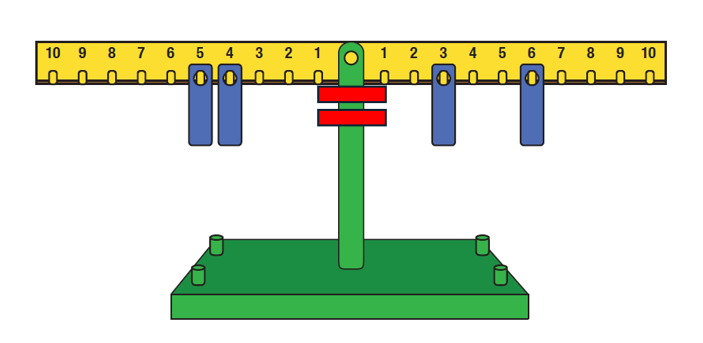
Following this discussion, set up the number balance with weights on 5 and 4 on one side of the balance and 3 and 6 on the other:

Ask: If I moved the weight on the 5 to the 6, where should I move the 4 to keep the numbers balanced?
Listen to student responses and determine that as the 5 increased by one, the 4 needs to decrease by one. Select students to use the physical number balance to show what happens to the weights to keep the balance. As students move the weights, discuss:
- why the numbers on each side still balance.
- whether the order of the numbers matter when adding them.
- how to change back to the original numbers.
- how to record the moves as a number sentence.
Show students Slide 4, which breaks down what students have been doing on the number balance.
Before clicking through the animation, ask what the totals of numbers are on one side, then the other. This is to establish that they are equal.
Show Slide 5 for students to see how the weights have moved but remain balanced.
Slides 6-7 may be used to further consolidate the mathematics underpinning students’ actions on the number balance.
Making the mathematics visible
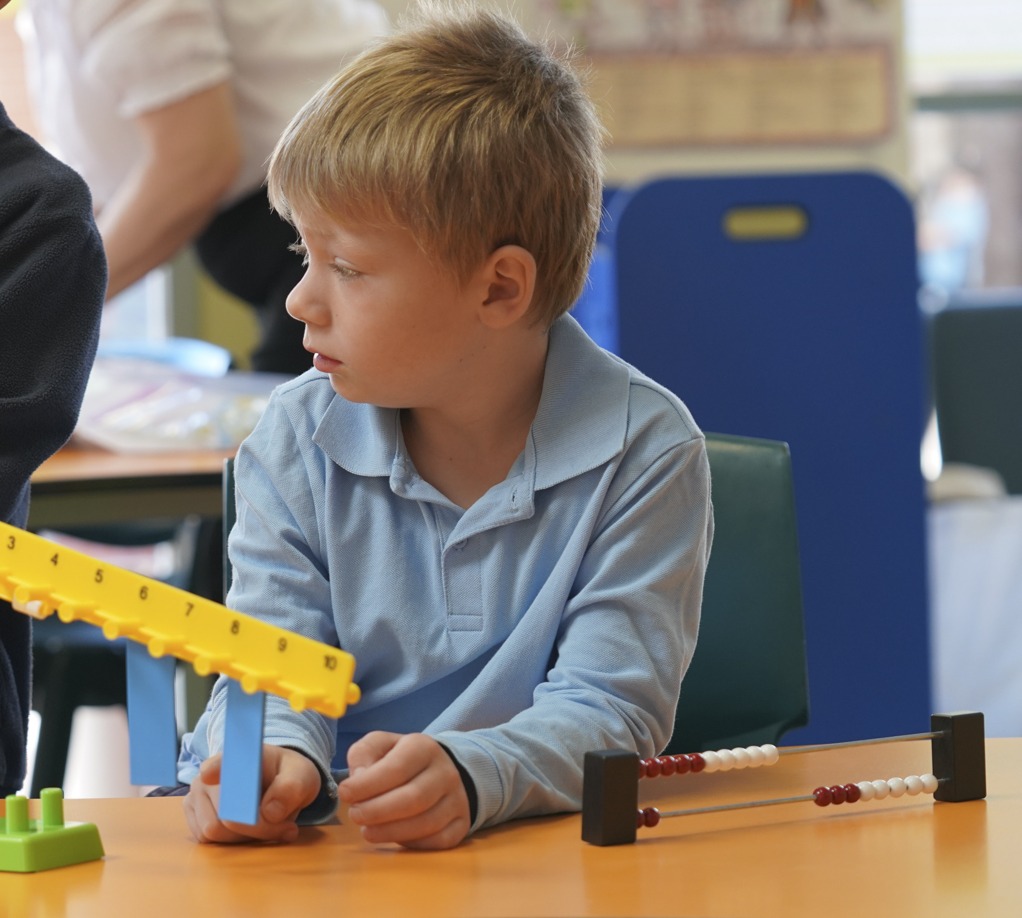
During the Connect phase, teachers use whole-class discussion to surface and examine the strategies students used to maintain balance on the number balance. As students share different combinations of numbers that keep both sides equal, the physical number balance becomes a tool for making their mathematical reasoning visible. Students model and explain the actions they took to move weights while preserving balance, providing a concrete representation of their thinking.
The number balance serves as a visual and spatial representation that supports students to communicate, justify and reflect on their reasoning. By encouraging students to think aloud as they manipulate the balance, teachers can draw attention to the mathematical relationships underpinning their actions and support students to make connections between what they do, what they say, and how those ideas can be represented mathematically.
A key pedagogical focus is supporting students to recognise that maintaining balance depends on preserving the relationship between both sides of the equation. Through purposeful questioning, teachers can guide students to notice how equivalent relationships are maintained and how these relationships can be represented using the equals sign.
Discussion prompts might include:
- Why do the numbers on each side still balance?
- How are these two sets of numbers equivalent?
- Can you change them back to the original numbers? What do you notice?
- Students may notice they are reversing, or using the inverse of, their previous action.
- How could you record what you have done mathematically?
As students share their reasoning, effective teacher actions include explicitly connecting:
- students’ concrete actions on the number balance.
- the mathematical language used to describe those actions and relationships.
- the symbolic representations used to record the relationships as equations.
Slides 4-5 of the Balancing act Slides are designed as reflection tools rather than instructional resources. Their purpose is to support discussion and sense-making after students have had opportunities to explore and explain their own strategies. Teachers may choose to use these slides to highlight and consolidate key mathematical ideas emerging from student responses, helping to make the underlying mathematics more visible and explicit.
Supporting students to move between visual models, mathematical language and symbolic representations strengthens their conceptual understanding of equality as a relationship rather than an operational process. Research suggests that spatial reasoning and the use of mathematical representations are important for developing students' conceptual understanding of the equals sign and for supporting algebraic thinking (Rich, 2018).
The remaining Task 1 slides may be used to further consolidate the mathematics underpinning students’ actions on the number balance. These slides provide opportunities for teachers to reinforce connections between concrete experiences, visual representations and abstract mathematical notation, supporting students to generalise their understanding of equivalence and balance.
References
Rich, K. (2018). Building conceptual understandings of equivalence [Doctoral dissertation, Boise State University]. Boise State University Theses and Dissertations. https://doi.org/10.18122/td/1416/boisestate
During the Connect phase, teachers use whole-class discussion to surface and examine the strategies students used to maintain balance on the number balance. As students share different combinations of numbers that keep both sides equal, the physical number balance becomes a tool for making their mathematical reasoning visible. Students model and explain the actions they took to move weights while preserving balance, providing a concrete representation of their thinking.
The number balance serves as a visual and spatial representation that supports students to communicate, justify and reflect on their reasoning. By encouraging students to think aloud as they manipulate the balance, teachers can draw attention to the mathematical relationships underpinning their actions and support students to make connections between what they do, what they say, and how those ideas can be represented mathematically.
A key pedagogical focus is supporting students to recognise that maintaining balance depends on preserving the relationship between both sides of the equation. Through purposeful questioning, teachers can guide students to notice how equivalent relationships are maintained and how these relationships can be represented using the equals sign.
Discussion prompts might include:
- Why do the numbers on each side still balance?
- How are these two sets of numbers equivalent?
- Can you change them back to the original numbers? What do you notice?
- Students may notice they are reversing, or using the inverse of, their previous action.
- How could you record what you have done mathematically?
As students share their reasoning, effective teacher actions include explicitly connecting:
- students’ concrete actions on the number balance.
- the mathematical language used to describe those actions and relationships.
- the symbolic representations used to record the relationships as equations.
Slides 4-5 of the Balancing act Slides are designed as reflection tools rather than instructional resources. Their purpose is to support discussion and sense-making after students have had opportunities to explore and explain their own strategies. Teachers may choose to use these slides to highlight and consolidate key mathematical ideas emerging from student responses, helping to make the underlying mathematics more visible and explicit.
Supporting students to move between visual models, mathematical language and symbolic representations strengthens their conceptual understanding of equality as a relationship rather than an operational process. Research suggests that spatial reasoning and the use of mathematical representations are important for developing students' conceptual understanding of the equals sign and for supporting algebraic thinking (Rich, 2018).
The remaining Task 1 slides may be used to further consolidate the mathematics underpinning students’ actions on the number balance. These slides provide opportunities for teachers to reinforce connections between concrete experiences, visual representations and abstract mathematical notation, supporting students to generalise their understanding of equivalence and balance.
References
Rich, K. (2018). Building conceptual understandings of equivalence [Doctoral dissertation, Boise State University]. Boise State University Theses and Dissertations. https://doi.org/10.18122/td/1416/boisestate
Explain: The equals sign (=) means “balance”. It shows that both sides have the same value as each other.
If you add 1 to a number on one side, you can subtract 1 from another number on the same side. Because the total on that side stays the same, the scales stay balanced.