

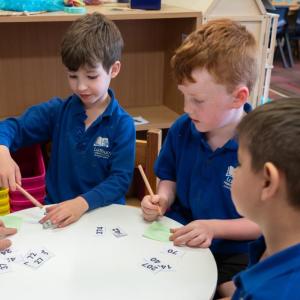
'Place value: What’s in a number' is a reimagining of classic sequence 'Place Value: Number Sorting'
- On the 'In this sequence' tab you'll find all the tasks in this sequence, a suggested implementation plan and curriculum alignment.
- The 'Behind this sequence' tab shows how key mathematical ideas develop over the sequence.
- Have you taught this sequence? Use the Feedback button to let us know how it went!
Tasks in this sequence

Task 1 • How will you sort it?
Students classify and sort numbers in different ways.
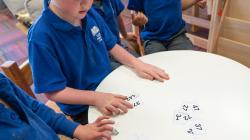

Task 2 • Number sort
Students sort various one-, two- and three-digit numbers to build their understanding of place value.
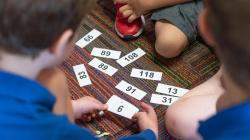
Task 3 • Similarities and differences
Students extend their thinking on properties of place value by using Venn diagrams to show similarities between numbers.
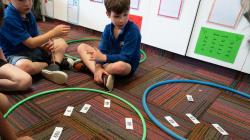
Task 4 • Place value sort
Students use a Venn diagram model to sort numbers using place value and explore why a number may belong to more than one group.
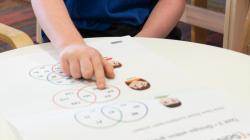
Task 5 • Place value understanding
Students identify place value properties of numbers in the intersection of Venn diagrams and complete the diagrams with numbers that reflect these properties.
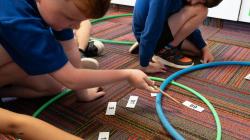
Suggested implementation
We recommend implementing this teaching sequence over five consecutive days, using the lesson timings provided in the documentation.
Curriculum and syllabus alignment
Year 2
By the end of Year 2, students order and represent numbers to at least 1000, apply knowledge of place value to partition, rearrange and rename two- and three-digit numbers in terms of their parts, and regroup partitioned numbers to assist in calculations.
Number
Partition, rearrange, regroup and rename two- and three-digit numbers using standard and non-standard groupings; recognise the role of a zero digit in place value notation
Each task in this sequence uses the Launch–Explore–Connect–Summarise task structure.
Place value is a complex concept that develops over time through sustained mathematical reasoning. Students may appear to understand place value by fluently counting or correctly naming digits in different place-value positions, however, many students do not yet have a deep understanding of how our number system works.
Understanding place value requires students to name, order, and represent numbers. It also requires them to recognise that our number system is based on ten, and to understand that 10 ones can be regrouped as 1 ten, 10 tens as 1 hundred, and so on.
There are 10 digits in our number system: 0, 1, 2, 3, 4, 5, 6, 7, 8 and 9. Using these digits, we are able to write an infinite range of numbers. The position of a digit in a number gives it its unit value, while the digit itself represents the number of units in that position. We calculate the place value of a digit by multiplying the digit by its positional value. For example:
- 24 = 2 tens + 4 ones
- 24 = (2 × 10) + (4 × 1)
Because students typically do not formally learn multiplication until the middle primary years, phrases such as “2 tens” or “4 ones” may hold little meaning for some learners. It is therefore important to explicitly connect these ideas to the value of the digits. For example, 2 tens is the same as 20, or the value of the digit 2 in 24 is 20.
This sequence supports students to develop an understanding of place value through a multiplicative lens by making the value of each digit explicit and meaningful, building foundations for later work with multiplication and more complex number concepts.
Sequence framework
This sequence framework presents an overview of the key elements in this sequence.
| Learning goals | Students’ mathematical activity | Representation | Context | |
|---|---|---|---|---|
| Task 1 | Numbers can be sorted and classified in different ways. Numbers are made up of digits. | Students sort numbers by finding ways in which they are alike. They define properties of numbers that are helpful to sort and classify them. | Number card sorting, physically grouping these according to student identified features/attributes. | Sorting and classifying numbers according to agreed-upon attributes/properties. |
Task 2
| Numbers can be sorted and classified using their properties. The position of a digit in a number gives it value. | Students notice that a digit has a different value depending on its position in a number and can be sorted according to this property. Students sort various one-, two- and three-digit numbers to build their understanding of place value. | Number card sorting, physically grouping these according to student identified features/attributes, including place value. | Sorting and classifying numbers according to place value properties, such as number of digits or noticing that the value of digit changes when it is in a different place in a number. |
| Task 3 | Numbers can be sorted and classified using place value properties. The position of a digit in a number gives it its unit value. A number is the sum of its unit values. | Students extend their thinking on properties of place value using a Venn model to group numbers. They notice that some numbers belong in more than one group. | Number card sorting, using Venn model to physically group number cards using properties of place value. | Sorting and classifying numbers according to place value properties, such as number of digits or value of a digit depending on its position in a number. |
| Task 4 | The position of a digit in a number gives it its unit value. A digit represents the number of units in a place value position. A number is the sum of its unit values. | Students build their understanding of grouping numbers using place value units of ones, tens and hundreds. Students develop their understanding that numbers which belong in the intersection have place value properties which overlap the two groups. | Place value sort board game to sort number cards into groups which share place value properties of the number in the intersection. | Place value sort board game provides opportunities for mindful practice to develop rules to sort and group numbers which share place value properties. |
| Task 5 |
The position of a digit in a number gives it its unit value. A digit represents the number of units in a place value position. A number is the sum of its unit values. | Students define the place value properties of the number in a Venn model intersection. They label the place value property for each group and generate their own numbers to follow the rule for each property. | Venn model with a number in one intersection challenges student to select properties of place value which apply to numbers needed in each group. | Venn model intersection provides the only clue to what numbers may belong in each of the groups which overlap at the intersection. |

'Place value: What’s in a number' is a reimagining of classic sequence 'Place Value: Number Sorting'
- On the 'In this sequence' tab you'll find all the tasks in this sequence, a suggested implementation plan and curriculum alignment.
- The 'Behind this sequence' tab shows how key mathematical ideas develop over the sequence.
- Have you taught this sequence? Use the Feedback button to let us know how it went!