

Place value: What’s in a number?
View Sequence overviewNumbers can be sorted and classified using place value properties.
The position of a digit in a number gives it its unit value.
A number is the sum of its unit values.
Whole class
What’s in a number? PowerPoint
Each group
Task 3 Number cards to sort set 1 Student sheet
Task 3 Number cards to sort set 2 Student sheet
A3 sheet of paper
One of the following:
- Glue & scissors (to cut up & stick number cards)
- Sticky notes & pencil (to write out each number on a sticky note)
Optional: 3 hoops/circle frames or similar, to allow students to engage with sorting using a Venn diagram in a concrete way.
Task
Revise: We sorted numbers into groups in different ways. An important idea is that the place of a digit in a number gives it value. The same digit has different values in different places in a number.
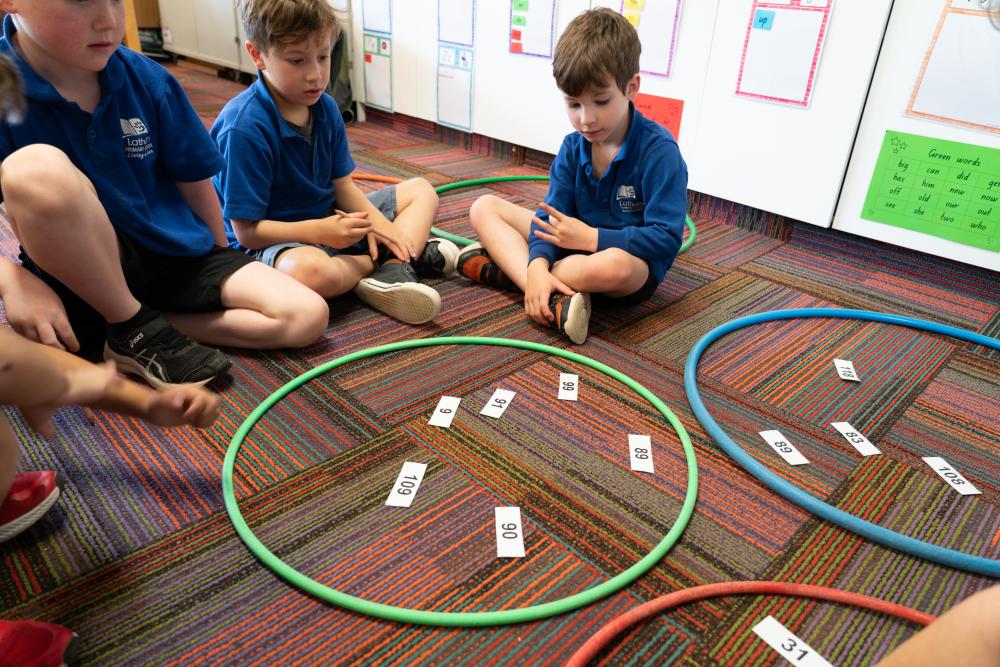
Show slide 10 of What’s in a number? PowerPoint to revisit using hoops to create a Venn diagram to sort numbers.
Discuss:
- how the hoops were useful for sorting numbers into groups.
- how the hoops were helpful to show numbers which belonged in more than one group.
- the sorting criteria used, focusing on place value properties: place/position, digit value, and place value units (hundreds, tens and ones).
Show slide 11 and recap why the number 190 belongs in more than one group.
Remind students to use what they know about how the position of a digit in a number gives it its value, to help them to sort number cards into groups.
Pose the task: How might you sort your numbers and what rules might you use to label each group ? Look out for numbers which might fit in more than one group.
Venn diagrams as a representation
Discuss how numbers with the same digits can belong in different groups because the place/position of a digit in a number holds value.
Explain: When we sort numbers using place value, we pay attention to where each digit is in the number. The place of a digit tells us how much it is worth; if it is worth a one, or a ten or a hundred. The digit tells us how many hundreds, or tens or ones there are in a number. When we change the place of a digit, this changes the value of the whole number.
You may choose to use concrete materials (such as pop sticks, ten frames, or Unifix cubes) to model some of the numbers on the cards to represent the concrete quantity alongside the number. This helps students see that although the digits change places, the materials cannot simply be swapped because they represent different unit values.
Discuss how numbers with the same digits can belong in different groups because the place/position of a digit in a number holds value.
Explain: When we sort numbers using place value, we pay attention to where each digit is in the number. The place of a digit tells us how much it is worth; if it is worth a one, or a ten or a hundred. The digit tells us how many hundreds, or tens or ones there are in a number. When we change the place of a digit, this changes the value of the whole number.
You may choose to use concrete materials (such as pop sticks, ten frames, or Unifix cubes) to model some of the numbers on the cards to represent the concrete quantity alongside the number. This helps students see that although the digits change places, the materials cannot simply be swapped because they represent different unit values.
Divide students into pairs to work together. Provide each pair with either Task 3 Number cards to sort set 1 Student sheet or Task 3 Number cards to sort set 2 Student sheet, A3 sheet of paper and either glue or sticky notes.
- Number cards to sort set 1 has examples of two-digit numbers where the digits have been swapped to build on Task 2. Number cards to sort set 2 has more three-digit examples of numbers with similar digits which are in different positions, which may be more challenging.
Allow students time to prepare (cut out/copy) the numbers to make a set of number cards and to sort their numbers into groups using place value properties to label their groups.
Students can use hoops/circles to create their Venn diagrams or draw circles around their groupings to show which numbers overlap.
- What do you notice about the number cards you have? What similarities are there between some numbers?
- How might you sort these numbers? What rules could you use to label each group?
- What do you know about the position of each digit in the number that may help?
- How can you label your groups to show that some numbers can belong to two groups?
Prompt students to consider if any of their numbers might even belong in three groups.
Ask them to think about ways to show how the numbers belong to more than one group.
- Have students organised their numbers using place value, focusing on the place of each digit (hundreds, tens and ones) in a number?
- Does each group have a clear label?
- Does their labelling allow for numbers to belong in more than one group?
- Have they created groups where numbers belong in more than one group?
- Are there numbers that do not fit in any group?
- Have they found numbers that belong in an intersection?
- Have some students found numbers belonging in multiple intersections?
Checkpoint: Highlight any examples of sorting where students have sorted numbers using place value properties. Draw student attention to different ways to categorise and label numbers using place value. Where a number fits in more than one group, encourage students to reason about why it belongs in the intersection.
Discuss:
- What similarities have been used to sort these numbers?
- The numbers might have the same digits in different places. For example, 13 and 31.
- Numbers in a group may have a particular number of hundreds, tens or ones. For example:
- has 1 hundred (or more than 10 tens)—109, 118, 108, 189.
- has 80 (or 8 tens)—83, 89, 189.
- Could you sort these numbers in a different way? How?
- Focus on the different ways that place value can be used to sort numbers. For example:
- each number has 9 ones—9, 89, 99, 109, 189.
- each number has more than 10 tens—118, 190, 308, 311.
- each number has 8 tens— 83, 89.
- Focus on the different ways that place value can be used to sort numbers. For example:
- Can you explain why this number belongs in more than one group?
- A number belonging to more than one group has the properties of all of the groups it belongs to. For example, 109 or 189 both have 1 hundred and 9 ones.
Allow students time to refine and make changes to how they have sorted and labelled their groups using place value, if they choose.
Students record their sorting on their A3 sheet and may glue/write the numbers and label each group.
Select two or three examples of student work that clearly show sorting based on place value properties, as well as numbers belonging to more than one group.
Checkpoint
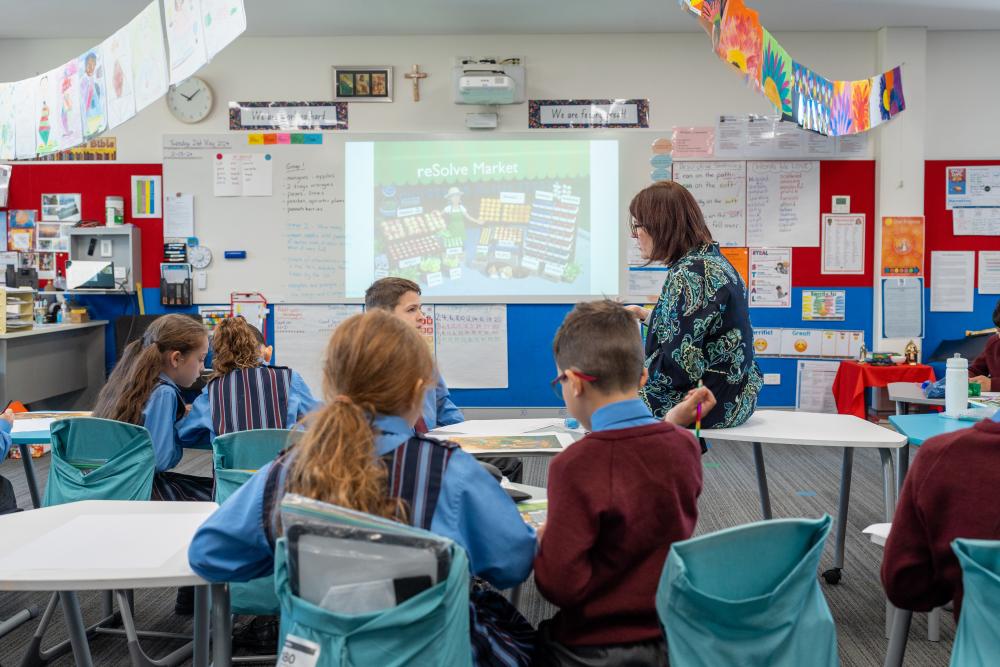
A checkpoint is used here as an opportunity to gauge student understanding by highlighting examples of student thinking that demonstrate number sorting using place value properties. It is a planned pause in the lesson where students share their work so far, look at how other groups are approaching the task, and raise any issues or challenges that have arisen.
These ideas are built through students noticing similarities between their own work and that of other students. This is especially helpful for students who may be feeling stuck as they can see how other students have sorted the numbers and build on their work.
Rather than the ideas coming solely from the teacher, the checkpoint helps develop a shared understanding that grows out of students’ work. It also allows you to intentionally ‘seed’ key mathematical ideas by carefully selecting which student work examples to share.
To support the idea that numbers have place value properties, look for student work that:
- uses place value concepts e.g. 27 is 20 and 7 or 2 tens and 7 ones.
- clearly labels place value properties.
- sorts numbers using criteria that allow numbers to belong to more than one group.
- shows (or prompts discussion about) why a number belongs in the intersection of two groups.
During the checkpoint, open questions can be especially powerful to encourage students to compare their own sorting categories and reasoning with what they notice in other groups’ work.
A checkpoint is used here as an opportunity to gauge student understanding by highlighting examples of student thinking that demonstrate number sorting using place value properties. It is a planned pause in the lesson where students share their work so far, look at how other groups are approaching the task, and raise any issues or challenges that have arisen.
These ideas are built through students noticing similarities between their own work and that of other students. This is especially helpful for students who may be feeling stuck as they can see how other students have sorted the numbers and build on their work.
Rather than the ideas coming solely from the teacher, the checkpoint helps develop a shared understanding that grows out of students’ work. It also allows you to intentionally ‘seed’ key mathematical ideas by carefully selecting which student work examples to share.
To support the idea that numbers have place value properties, look for student work that:
- uses place value concepts e.g. 27 is 20 and 7 or 2 tens and 7 ones.
- clearly labels place value properties.
- sorts numbers using criteria that allow numbers to belong to more than one group.
- shows (or prompts discussion about) why a number belongs in the intersection of two groups.
During the checkpoint, open questions can be especially powerful to encourage students to compare their own sorting categories and reasoning with what they notice in other groups’ work.
The purpose of this Connect phase is to for students to understand that:
|
Bring the class together to sit in a circle on the floor. Invite selected students to describe and explain how they sorted the numbers and how they chose their categories/labels. These students model their sorting using the hoops on the floor while other students observe.
Using talk moves, prompt students to think aloud so that other students have an insight into their thinking and sorting strategies, and revoice their discourse when needed to ensure that the class hears the mathematical language used correctly and accurately.
Discuss:
- How have these numbers been sorted?
- If I rearranged the digits into a new number would it belong in the same group? Why/why not?
- How do I know what the whole number is worth?
- What do you notice about the numbers where the two circles overlap?
- Why does this number belong in both groups?
Discuss with the class:
- the similar/different sorting categories/labels students used.
- any numbers that belong in more than one group and why they belong in those groups.
Invite other students to share any different place value categories/labels from their sorting and explain their choices.
Discuss how numbers with the same digits can belong in different groups because the place/position of a digit in a number holds value.
Explain: When we sort numbers using place value, we pay attention to where each digit is in the number. The place of a digit tells us how much it is worth: if it is worth a one, or a ten or a hundred.
You may choose to use concrete materials (such as pop sticks, ten frames, or Unifix cubes) to model some of the numbers on the cards to represent the concrete quantity alongside the number. This helps students see that although the digits change places, the materials cannot simply be swapped because they represent different unit values.