

Mathematical modelling: What makes us happy?
View Sequence overviewStatistical investigations begin with questions that we can explore using data.
Scatterplots help us see relationships between two numerical variables.
Whole class
What makes us happy? PowerPoint
Each group
Sticky notes
Each student
Access to a computer and the online data analysis tool CODAP (https://codap.concord.org/). Alternatively, students can work together in pairs with a shared computer.
Task
Pose the question: What makes you happy?
Arrange students in groups and give each group a set of sticky notes. Responding to the question “What makes you happy?”, students generate as many ideas as they can, writing one idea per sticky note. Once they have a good collection, they sort and cluster their sticky notes into common themes. For example, “spending time with friends” and “talking to family” might both fit under a “relationships” category. After sorting their ideas, each group shares their categories with the class so the class can build one combined list of themes.
Discuss:
- What similarities do you notice between the categories that different groups created?
- Are there categories that everyone seems to agree are important?
- Are there any categories where there’s very little agreement?
- What might explain the differences between groups’ ideas, and what does this tell us about the range of factors that contribute to happiness?
Idea clustering
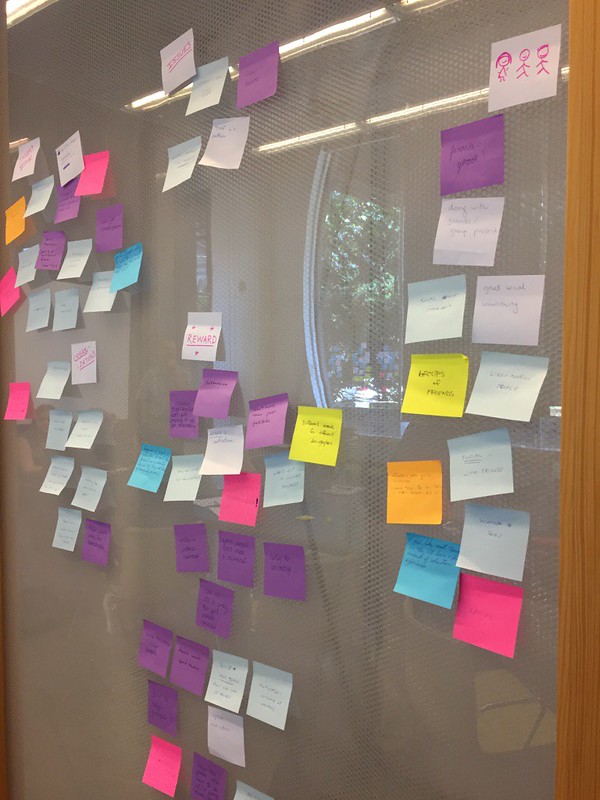
Clustering is a process where students group individual ideas into meaningful categories, helping them see patterns that aren’t obvious when ideas sit on their own. In statistics, this mirrors the way analysts look for underlying factors that might influence an outcome (e.g. identifying clusters of variables that relate to happiness). Clustering is also a common technique in qualitative research. For example, researchers might look across many people’s responses to identify common patterns or themes in what groups of people are saying.
Pedagogically, clustering works because it encourages students to generate lots of ideas quickly, without worrying about correctness or quality. Having students write one idea per sticky note keeps the task low-stakes and accessible, especially for students with lower literacy. It is inherently collaborative: groups pool their ideas, negotiate how to sort them, and justify why certain ideas belong together. This builds communication and teamwork skills.
Clustering is a process where students group individual ideas into meaningful categories, helping them see patterns that aren’t obvious when ideas sit on their own. In statistics, this mirrors the way analysts look for underlying factors that might influence an outcome (e.g. identifying clusters of variables that relate to happiness). Clustering is also a common technique in qualitative research. For example, researchers might look across many people’s responses to identify common patterns or themes in what groups of people are saying.
Pedagogically, clustering works because it encourages students to generate lots of ideas quickly, without worrying about correctness or quality. Having students write one idea per sticky note keeps the task low-stakes and accessible, especially for students with lower literacy. It is inherently collaborative: groups pool their ideas, negotiate how to sort them, and justify why certain ideas belong together. This builds communication and teamwork skills.
Pose the question: How might we measure happiness?
Discuss how statisticians take a set of possible factors, such as the ones generated through clustering, and treat them as “hunches” that need to be tested using data. Numerical data is especially useful because it allows us to make clear comparisons, helps us to generate patterns, and makes it possible to measure how strong relationships might be, even though qualitative data can still add depth and context.
Based on the categories each group has identified, students create questions with numerical answers that could be asked to a wide range of people to evaluate how happy they are.
- Are students creating questions that don’t actually produce numerical data?
- For example, open-ended “Why…” questions.
- Are students choosing measures that don’t really match the category?
- For example, measuring “exercise” with a yes/no instead of asking “How many minutes per week?”.
- Are students combining multiple ideas into one question, making it unclear what is being measured?
- “How often do you exercise and eat healthy food each week?” mixes two different behaviours into a single response.
- Are students offering too few or too many response options, limiting choice or making the scale feel arbitrary?
- For example, giving only “1, 2, or 3” as options for happiness, or offering a 1–100 scale that feels excessive.
- Are students choosing scales with an odd or even number of scale points, and do they understand that an odd number creates a neutral middle?
- A 1–4 scale has no neutral point, versus a 1–5 scale with a neutral point of 3.
Show slide 6 of What makes us happy? PowerPoint. This slide introduces the World Happiness Report. Explain that this is an annual report that compares levels of happiness across countries based on data from the Gallup World Poll.
Show slide 7 and introduce the Cantril Ladder, a tool used in social research. Explain that the Cantril Ladder is used in the Gallup World Poll to measure happiness globally. You can learn more about the Cantril Ladder in the embedded professional learning Quantifying happiness below.
Discuss:
- How is this poll similar to and different from the questions that we proposed as a class?
- The Cantril Ladder score is a direct, overall measure of a person's life satisfaction (happiness itself), whereas many of the student-generated questions are likely to focus on specific factors that may influence happiness, rather than measuring happiness directly.
- Many of the student-generated questions will likely use a numerical scale, while the ladder uses a visual metaphor and measures the outcome rather than the causes.
- Do you think this is a valid way to measure happiness? Why, or why not?
- The Cantril Ladder score provides a consistent, comparable measure that works well for large groups of international surveys.
- What issues could there be with asking this question?
- The Cantril Ladder score is a self-reported, subjective measure, and therefore cannot capture the reasons behind someone’s rating.
- Terms like “best possible life” may be interpreted differently by different people. Responses can be influenced by mood, culture, or context, and a single question may oversimplify a complex idea.
Quantifying happiness
Happiness is not straightforward to measure. It is a subjective concept, and people’s interpretations of what it means to be “happy” can vary widely depending on factors such as culture, personal experiences, community, and individual values.
Many factors related to happiness are categorical in nature, which makes it difficult to quantify happiness and compare it across countries. To make comparisons, researchers need to represent people’s experiences using numerical data, which allows patterns to be identified and summaries, such as averages, to be calculated.
One commonly used approach in social research is the Cantril Ladder, which is used in the Gallup World Poll to measure happiness and published in the World Happiness Report. Participants are asked to respond to the following question:
Please imagine a ladder, with steps numbered from 0 at the bottom to 10 at the top. The top of the ladder represents the best possible life for you, and the bottom of the ladder represents the worst possible life for you. On which step of the ladder would you say you personally feel you stand at this time? (Helliwell et al. 2025, p.89)
While the Cantril Ladder is a well-established tool in social research, it is not without criticism. For example, respondents may interpret the phrase “best possible life for you” in terms of power or wealth rather than wellbeing, relationships, or happiness. In addition, the ladder metaphor itself may imply hierarchy and social status, which can influence how people position themselves on the scale.
Happiness is not straightforward to measure. It is a subjective concept, and people’s interpretations of what it means to be “happy” can vary widely depending on factors such as culture, personal experiences, community, and individual values.
Many factors related to happiness are categorical in nature, which makes it difficult to quantify happiness and compare it across countries. To make comparisons, researchers need to represent people’s experiences using numerical data, which allows patterns to be identified and summaries, such as averages, to be calculated.
One commonly used approach in social research is the Cantril Ladder, which is used in the Gallup World Poll to measure happiness and published in the World Happiness Report. Participants are asked to respond to the following question:
Please imagine a ladder, with steps numbered from 0 at the bottom to 10 at the top. The top of the ladder represents the best possible life for you, and the bottom of the ladder represents the worst possible life for you. On which step of the ladder would you say you personally feel you stand at this time? (Helliwell et al. 2025, p.89)
While the Cantril Ladder is a well-established tool in social research, it is not without criticism. For example, respondents may interpret the phrase “best possible life for you” in terms of power or wealth rather than wellbeing, relationships, or happiness. In addition, the ladder metaphor itself may imply hierarchy and social status, which can influence how people position themselves on the scale.
Provide students with access to computers and ask them to access the World Happiness map. Allow time for students to investigate how happiness ratings vary across countries.
Discuss:
- How does Australia’s happiness rating compare to other countries around the world? Why might this be?
- Australia has a comparatively high happiness rating. Students might attribute this to factors such as wealth, security, and education.
- What factors do you think contribute to the happiness of a country? What makes you say this?
- Students may notice that wealthier countries tend to be happier. These countries typically have greater access to resources and education which may also contribute to happiness.
Let students know that these initial observations suggest that measurable factors, such as wealth or access to resources, may be related to reported happiness, and these relationships can be explored using data.